AI shopping has acquired a measurement problem before most stores have acquired meaningful AI revenue. A buyer may discover a product in ChatGPT, compare it in Gemini, return through branded search, and buy on a phone. Another order may complete inside an agentic channel without a normal website session. A dashboard that counts only referral clicks misses the first journey; a vendor report that claims every mention as revenue exaggerates the second.
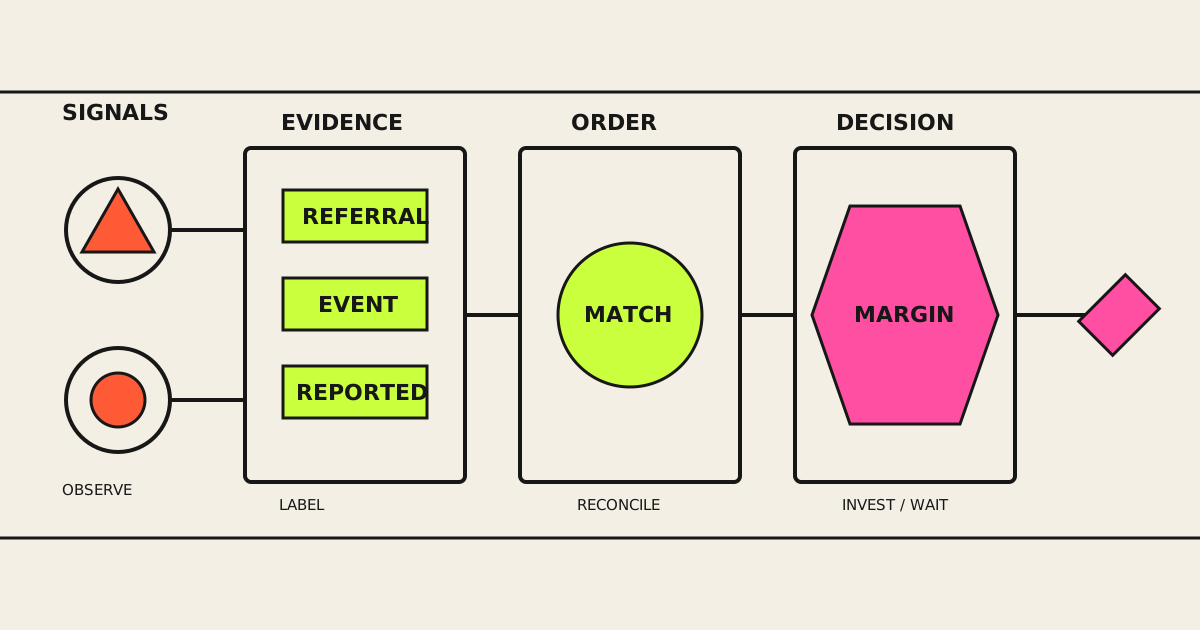
The practical answer is not a new magic attribution model. It is an evidence ladder: separate what you can observe directly from what you can only infer, join channel evidence to orders, and judge the channel on contribution margin and customer quality—not screenshots of rising sessions.
What changed in 2026
Google Analytics now includes an AI Assistant channel in its Default Channel Group. Google says it identifies traffic from assistants such as ChatGPT, Gemini, and Claude. That removes some manual classification work, but it does not make AI influence fully visible. A recommendation can produce no click, an AI browser can obscure a referrer, and an in-chat purchase can bypass the store’s normal analytics path.
The channel is worth measuring. Adobe reported that traffic from AI sources to US retail sites grew 393% year over year in the first quarter of 2026. Shopify separately reported eightfold year-over-year growth in AI-driven traffic and nearly thirteenfold growth in orders from AI-powered searches in Q1 2026. These are platform-level observations, not a forecast for an individual store. They justify instrumentation; they do not justify an assumed return.
McKinsey’s June 2026 European ecommerce research frames AI as part of a broader reset of growth and competition. The operational implication is simple: discovery, transaction, and retention can be controlled by different surfaces. Measurement has to follow the customer and the order across those boundaries.
Use four evidence classes, not one AI number
| Evidence | What it proves | What it does not prove |
|---|---|---|
| Observed referral | A visit arrived with a recognised AI source | That the assistant caused the eventual purchase |
| Tagged channel event | A platform or campaign passed a stable source identifier | All earlier research or later cross-device activity |
| Order-level record | A source, transaction ID, value, and outcome can be joined | Incrementality without a comparison |
| Reported influence | A customer says an assistant affected the decision | Precise causal credit or revenue allocation |
Keep these classes distinct in reports. “AI-referred revenue” can be a defensible observed metric. “AI-influenced revenue” is a broader estimate and should be labelled as such. Do not add both together: the same order can appear in each class.
Layer 1: instrument the visit and the order
Start with the ordinary commerce path. In GA4, inspect the AI Assistant channel, then break it down by session source, landing page, device, country, and new versus returning customer. Confirm the classification against raw referrer values or server logs where available. Keep a maintained allowlist of relevant domains for tools that your analytics product has not yet classified.
For links that you control—partner placements, merchant profiles, platform storefronts, or test campaigns—use consistent UTM parameters. Google’s official URL-builder guidance documents campaign parameters for identifying referring campaigns. A workable convention is:
utm_source=chatgpt
utm_medium=ai_assistant
utm_campaign=agentic_storefront
utm_content=product_recommendation
Do not attach invented UTMs to links you do not control, and do not expect an assistant to preserve them. Tags are strong evidence when present, not proof of absence when missing.
Your commerce implementation must send a stable transaction ID, revenue, currency, product IDs, quantity, discount, shipping, and refund events. Google defines a key event as an action important to the business; a purchase is useful only when it reconciles with the actual order system. Deduplicate retries. Exclude test orders. Preserve the initial channel evidence on the order or customer record instead of letting a later direct visit overwrite it.
Layer 2: capture transactions that never create a normal session
Agentic commerce can move checkout into an external interface. In that case, website analytics may see no page view at all. Treat the channel’s order payload, webhook, or platform report as a first-party integration source. Store at least:
- merchant order ID and external transaction ID;
- channel, surface, and integration version;
- created, authorised, paid, fulfilled, cancelled, and refunded timestamps;
- gross value, discounts, tax, shipping, payment cost, and estimated product cost;
- SKU and variant IDs that match the catalogue source of truth;
- new or existing customer status where lawfully available;
- consent and audit fields required by the implemented flow.
Reconcile external transactions against the order-management or ERP ledger every day. One external transaction should map to one merchant order; status changes should update rather than create duplicate revenue. If the platform provides only aggregate reporting, record that limitation. Do not manufacture order-level certainty from a summary chart.
Layer 3: estimate dark AI influence honestly
A recommendation without a click is not directly attributable. You can still collect directional evidence. Add a short optional post-purchase question such as “What first put us on your shortlist?” with specific assistant choices plus search, social, friend, marketplace, and other. Rotate the order of answers, allow free text, and store the response separately from observed acquisition data.
Watch branded search, direct landings on deep product pages, assisted conversions, and customer-service notes for changes. These are indicators, not revenue claims. A spike may have another cause: a creator mention, PR coverage, seasonality, or a promotion.
For a larger programme, run controlled tests. Improve product evidence for a defined category while holding another comparable category unchanged, or phase the launch by market. Compare qualified traffic, conversion, margin, cancellation, and returns over a period long enough to absorb ordinary volatility. This is still quasi-experimental unless assignment is random; state that limitation.
The weekly AI-commerce scorecard
| Layer | Primary metric | Guardrail |
|---|---|---|
| Discovery | AI sessions and eligible product landings | Coverage and classification drift |
| Intent | Product views, add-to-cart, checkout start | Bot filtering and event duplication |
| Transaction | Orders and net revenue by evidence class | ERP reconciliation |
| Economics | Contribution margin per order | Fees, discounts, fulfilment, returns |
| Customer | New-customer rate and repeat purchase | Consent, identity confidence, cohort age |
| Operations | Cancellation and support-contact rate | Small samples and category mix |
Report counts beside percentages. Five orders with a 40% repeat rate are not equivalent to five thousand. Use confidence intervals or, at minimum, flag small cohorts. Segment by category and country because a blended conversion rate can hide that the channel works for considered purchases but not replenishment—or the reverse.
Protect the customer relationship while you measure it
Adyen’s co-CEO warned in August 2026 that merchants are focused on protecting loyalty as assistants take on more of the shopping process. Measurement should reveal whether an AI channel creates a durable customer or merely rents an order back to the merchant.
Track account creation, permitted lifecycle opt-in, first-party service interactions, second purchase, and direct return visits. Do not coerce consent or hide the seller behind the channel. Make fulfilment, returns, warranty, and support unmistakably yours. A channel with strong first-order revenue but weak margin, high returns, and no repeat relationship may be strategically worse than a smaller source of loyal customers.
A 30-day implementation plan
Assign one owner for taxonomy and one business owner for the decision. Document source mappings, exclusions, timezone, currency conversion, attribution window, and refund lag. Version the definition of “AI order.” When a platform or analytics product changes its classification, annotate the report rather than pretending the trend is organic.
What this measurement cannot tell you
No practical setup observes every model answer, copied product name, private chat, cross-device journey, or offline purchase. Referral data can disappear. Surveys have recall bias. Platform reports use their own definitions. Last-click attribution systematically understates discovery that happens earlier, while broad “influenced revenue” can overstate it.
The objective is decision-grade evidence, not perfect credit. If the data cannot distinguish a real order from a modelled influence, show both. If a cohort is too small, wait. If the channel cannot provide identifiers or reconciled outcomes, cap investment until it can.
Frequently asked questions
Does GA4 now track ChatGPT and Gemini traffic automatically?
Google Analytics has added an AI Assistant channel for recognised sources including ChatGPT, Gemini, and Claude. Verify what appears in your property and inspect source-level data; no default channel captures recommendations that generate no identifiable visit.
What is the difference between AI-referred and AI-influenced revenue?
AI-referred revenue is tied to observable source evidence. AI-influenced revenue includes reported or inferred assistance without a clean referral. Keep the measures separate and never sum overlapping orders.
How should an in-chat purchase be tracked?
Persist the external channel and transaction ID on the merchant order, process status updates idempotently, and reconcile payments, refunds, cancellations, and fulfilment with the order ledger.
Which AI-commerce KPI matters most?
Use contribution margin from reconciled orders as the commercial anchor, then examine new-customer quality, repeat purchase, cancellations, returns, and support cost.
How long before we judge the channel?
Long enough to include refunds and a meaningful cohort. There is no universal period: volume, buying cycle, return window, and seasonality determine it.
Sources and verification date
Verified 18 August 2026 against the official Google Analytics release notes, key-event documentation, and campaign URL guidance; Adobe Digital Insights Q1 retail analysis; Shopify’s Q1 2026 commerce data; McKinsey’s European ecommerce agenda; and Reuters’ 13 August 2026 report on AI shopping and merchant loyalty. Product behaviour and channel definitions can change; verify them in your property and contracts.
Next: run the AI shopping readiness audit, compare the investment with the automation ROI framework, or discuss an agentic-commerce measurement layer with Rendframe.