Your next high-intent shopper may never browse your category page. They may ask an AI to find a waterproof commuter backpack under £140, compare delivery dates, reject weak return policies, and bring back three options. If your catalog cannot answer those constraints cleanly, the agent does not have enough evidence to recommend you.
In 2026, the practical opportunity is not fully autonomous shopping everywhere. It is AI-mediated discovery and comparison now, with transaction capabilities arriving unevenly by platform, country, and merchant eligibility. McKinsey's March 2026 European research describes exactly that gap: decision influence is already here while execution is still developing.
This audit helps an ecommerce team prepare without buying a speculative “agentic” stack. It separates work that improves ordinary search and conversion today from integrations that only make sense once a channel is available to your store.
The short answer: make the offer computable before making it conversational
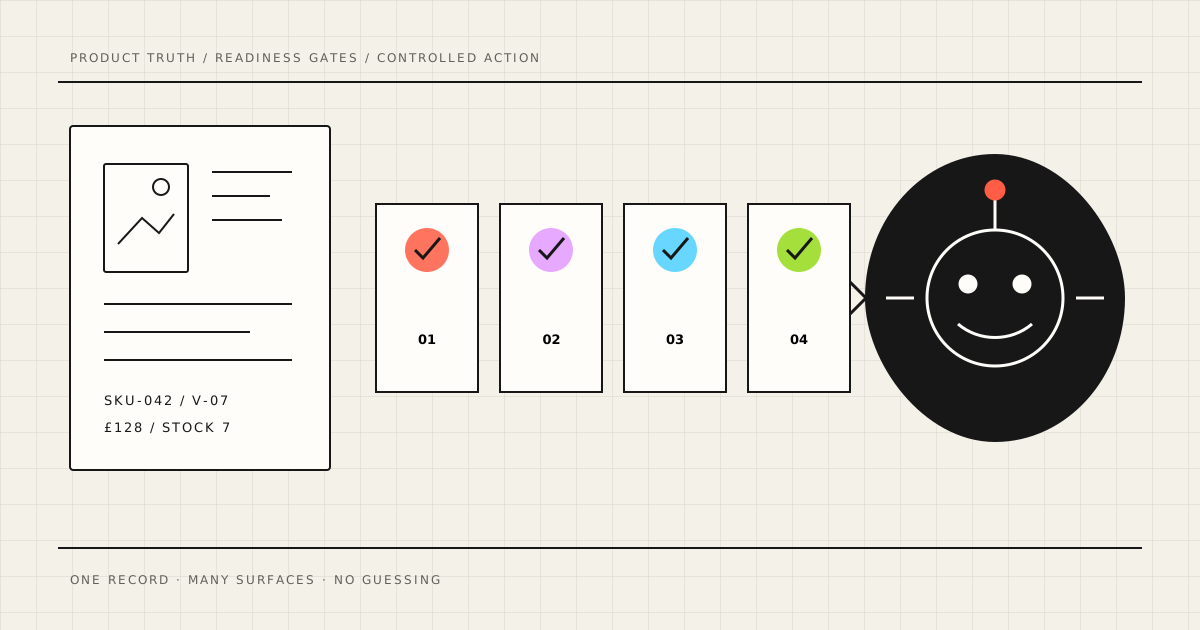
An AI shopping system needs to determine five things: what the product is, which variant fits, what it costs now, whether it can arrive under the buyer's constraints, and what happens if the purchase goes wrong. Put those answers in one consistent product record, the page, structured data, and every feed. Then test the journey from discovery to a reversible checkout.
Identity
Stable IDs, variants, attributes, images, and canonical URLs.
Evidence
Specific claims, machine-readable offers, compatibility, and provenance.
Terms
Live price, stock, delivery, returns, taxes, and market eligibility.
Action
Reliable cart, authorization, fraud controls, support, and audit trail.
What changed—and what did not
Google announced Universal Commerce Protocol in January 2026 and said it would support discovery, purchase, and post-purchase interactions across agents and merchant systems. OpenAI's current Agentic Commerce documentation starts merchant onboarding with a structured product feed; its product specification accepts Google-compatible formatting. Shopify now documents UCP-compliant catalog and checkout interfaces for agents.
Those are meaningful infrastructure moves. They do not mean every merchant can switch on every channel today. OpenAI states that product-feed onboarding is available to approved partners, while individual capabilities and geographic availability continue to differ. Build the portable foundation first: accurate catalog data, explicit policy, discoverable pages, and measurable checkout. Treat a protocol connection as a distribution project, not the foundation itself.
A 100-point AI-shopping readiness audit
| Area | Points | Pass condition |
|---|---|---|
| Product identity and variants | 20 | A system can distinguish every sellable item without guessing |
| Attributes and decision evidence | 20 | Material, dimensions, compatibility, use, and limits are explicit |
| Price, stock, delivery, and returns | 20 | Terms are current, market-specific, and consistent |
| Pages, structured data, and feeds | 20 | Machine-readable records agree with visible customer content |
| Checkout, governance, and measurement | 20 | Actions are authorized, observable, reversible, and supported |
Score each test 0 for absent, 1 for partial, and 2 for reliable; use ten tests per area. A score below 60 means fix data and operations before discussing a new commerce protocol. Between 60 and 80, run controlled discovery pilots. Above 80, evaluate channel-specific integration against actual eligibility and commercial value. These thresholds are a planning heuristic, not an industry benchmark.
1. Build one source of product truth
Start with stable product and variant identifiers. Use valid GTINs where they exist; do not invent them. Keep brand, manufacturer part number, item group, colour, size, material, condition, and category in dedicated fields. A title should identify the object and its defining variant—not carry every keyword the marketing team can fit.
For each variant, verify the image, landing URL, price, currency, stock state, and shipping weight. A red 38 and a black 42 are different purchasable records even when they share a parent page. If the feed says “in stock” while checkout says otherwise, the technically valid feed is still operationally false.
Create a sample of 30 products: ten best sellers, ten high-margin products, and ten messy long-tail records. Ask a person unfamiliar with the catalog to answer a realistic constraint query using only the fields. Every clarifying question they need reveals a missing attribute or an overloaded free-text description.
Write attributes for decisions, not decoration
“Premium performance jacket” gives an agent almost nothing to compare. “Three-layer waterproof shell; 20,000 mm hydrostatic head; 420 g in size M; helmet-compatible hood; no insulated lining” supports an actual decision. The same rule applies to furniture dimensions, cosmetic ingredients, replacement-part compatibility, food allergens, software licence limits, and battery runtime.
Separate verified specifications from editorial claims. Record the source and review date for material assertions. Never turn an inference—“probably fits model X”—into a compatibility fact. A recommendation engine that confidently repeats bad data creates support costs, returns, and loss of trust.
2. Make the product page agree with the record
The visible page remains part of the evidence. Give each sellable product a canonical, accessible URL with a descriptive heading, usable text, current offer details, meaningful images, and variant selection that changes the URL or exposes a stable variant identifier. Do not hide essential specifications exclusively in an image, PDF, accordion that never renders, or client-side request a crawler cannot reliably reach.
Use Product and Offer structured data where the page genuinely sells that product. Google documents richer merchant-listing properties for price, availability, shipping, returns, and variants. Follow its required and recommended properties, then validate both markup and visible content. Structured data is a description of the page—not a second catalog in which better terms can be advertised.
- the page, JSON-LD, merchant feed, and checkout show the same price and currency;
- availability uses a supported state and changes when inventory changes;
- variant markup maps to the exact purchasable SKU;
- images are crawlable, high quality, and show the actual variant;
- reviews and ratings are marked up only when they are real and eligible.
3. Turn delivery and policy into data
A buyer rarely asks only for “the best” product. They add constraints: arrive before Friday, ship to Malmö, fit a 14-inch laptop, allow return after trying at home. Product relevance therefore depends on operations.
Make shipping destinations, cut-off times, handling time, delivery range, cost, return window, return cost, condition requirements, warranty, and support route explicit. Use customer-facing dates where the platform permits them and define exceptions for oversized, made-to-order, perishable, or final-sale items. “Fast shipping” and “easy returns” are slogans, not executable terms.
Test five addresses across your actual markets. Compare the promise on the product page with the rate and date at checkout. If operations cannot honour the promise, fix the operation or narrow the claim. Do not solve inconsistent fulfilment with more schema.
4. Treat feeds as production systems
OpenAI, Google, marketplaces, affiliates, and social-commerce channels may consume different schemas, but they should be generated from the same governed records. Map fields once, version the transformation, validate output automatically, and monitor rejected or stale items.
| Check | Failure to detect | Control |
|---|---|---|
| Completeness | Required ID, title, price, URL, or image missing | Schema validation before publish |
| Freshness | Feed price or stock lags the store | Timestamp, refresh SLA, drift alert |
| Consistency | Landing page conflicts with feed | Daily sampled comparison |
| Variants | Size or colour points to wrong item | Parent-child and URL tests |
| Coverage | Only easy products are eligible | Eligible-SKU ratio by category |
Track product eligibility, rejection reasons, freshness lag, clicks or referrals, add-to-cart, completed orders, cancellations, returns, and support contacts by channel. A discovery surface that sends poorly matched customers is not automatically valuable because traffic increased.
5. Keep control at checkout
When an agent can create carts or initiate checkout, the merchant still needs an authoritative total, inventory check, delivery promise, tax calculation, consent record, fraud decision, order confirmation, and support path. Never trust a price or SKU supplied by a client without server-side validation.
Make the customer approve material terms before commitment. Preserve a readable order summary and a human handoff. Log which channel or agent initiated the journey without storing unnecessary prompt content or sensitive personal data. Design cancellation, return, duplicate-order, timeout, and unavailable-item paths before celebrating the happy path.
Payments and delegated authorization require channel-specific security and compliance review. Protocol compatibility does not remove PCI, privacy, consumer-protection, sanctions, tax, or accessibility obligations. Use your payment provider's supported integration and involve legal and risk owners for the markets you serve.
A seven-day readiness sprint
The deliverable is a scored audit, corrected sample, field dictionary, source owner, refresh SLA, test queries, and ranked backlog. Only then decide whether to extend the cleanup across the catalog or build a channel integration.
What this work will not guarantee
Clean data does not guarantee inclusion, ranking, recommendation, or sales in any AI product. Platforms choose eligibility and presentation, models can misunderstand information, and supported markets change. Demand may remain conventional search-led for your category. Measure incremental value instead of relabelling all existing revenue as “agentic.”
The durable benefit is less glamorous and more useful: fewer catalog contradictions, better merchant-listing eligibility, clearer product decisions, more reliable support answers, and lower integration cost when a channel becomes relevant.
Frequently asked questions
What is agentic commerce?
It is commerce in which AI agents help discover, compare, select, and sometimes purchase products on a person's behalf. Autonomy varies by channel and stage of the journey.
Does my store need UCP or ACP now?
Not automatically. Confirm merchant eligibility, markets, supported capabilities, implementation cost, and measurable demand. Accurate product data and checkout remain the prerequisite.
How do I make products discoverable in ChatGPT?
OpenAI's current merchant route begins with a structured product feed and is available to approved partners. Follow current official onboarding documentation; do not assume a generic plugin guarantees inclusion.
Is Product schema enough for AI shopping?
No. Structured data helps systems understand pages, but freshness, complete feeds, variant identity, delivery, policy, availability, and reliable checkout also matter.
Which products should I audit first?
Use a mixed sample of best sellers, high-margin items, and messy long-tail SKUs. That exposes both commercial opportunity and systemic data debt.
Sources and review date
Reviewed 17 August 2026 against McKinsey's European agentic-commerce research and its global report; official OpenAI Agentic Commerce, product-feed specification, Google UCP announcement, Shopify agent documentation, Google product-data specification, and Google Product structured-data guidance. Availability and specifications can change; check the linked documentation before implementation.
Continue: see Rendframe's agentic-commerce systems work, prepare the wider business for AI, and audit the human checkout before adding another channel.