The best CRM is not the one with the longest feature list. It is the one a salesperson still updates after a difficult call at five in the afternoon. If the system loses at that moment, everything else is decoration.
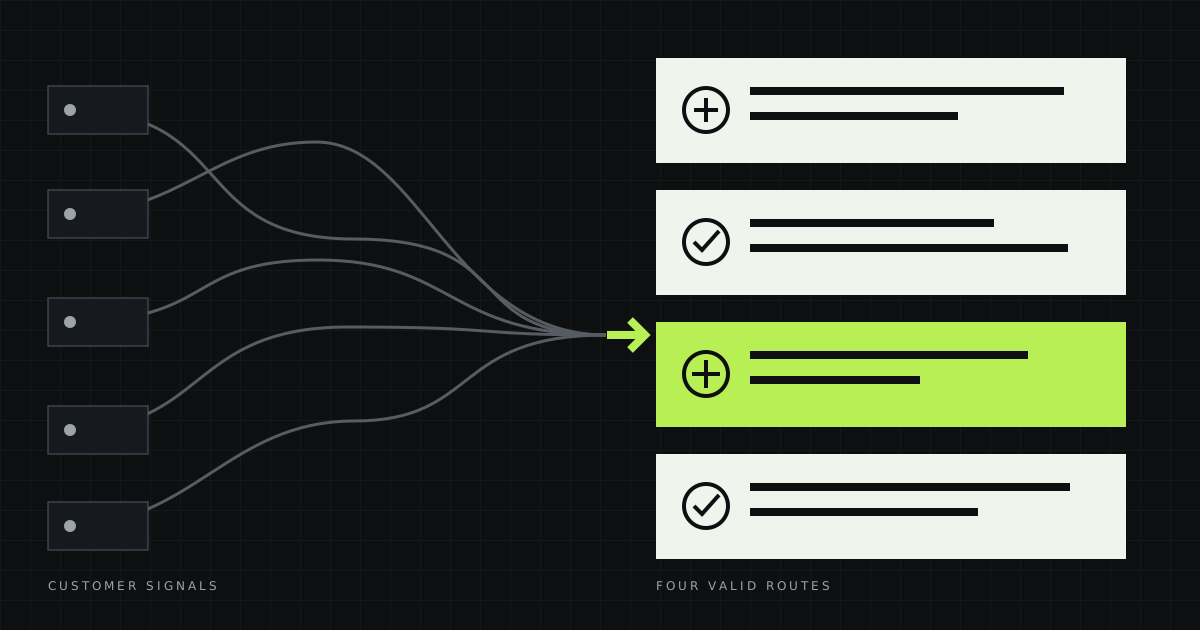
“What is the best CRM for a small business?” hides a better question: what behavior are you trying to make normal? Moving deals and next actions every day? Giving marketing, sales, and support one customer record? Modelling non-standard relationships? Building many workflows while controlling cost?
We compare HubSpot, Pipedrive, Attio, and Zoho CRM by operating model, not checkbox count. There are no affiliate links. Prices were verified on August 16, 2026 using official pages; regional currency, tax, promotions, and terms may differ.
The short answer
Pipedrive
The clearest route to pipeline discipline and next actions.
HubSpot
When marketing, sales, and service need one customer history.
Attio
For a modern team that needs flexible objects and relationships.
Zoho
When customization, automation, and cost control matter most.
- Pipedrive is the best default for a small, direct B2B sales team.
- HubSpot is best when CRM is becoming part of a broader customer platform.
- Attio fits startups, partnerships, recruiting, or any model where a deal is not the only important object.
- Zoho CRM suits budget-conscious teams with more complex processes and an appetite for configuration.
Do you need a CRM yet?
A spreadsheet is still reasonable when one or two people sell, the number of active opportunities is small, the cycle is short, and every customer has one obvious owner. A CRM becomes useful when follow-ups disappear into inboxes, two people contact the same lead, deal stalls are invisible, history leaves with an employee, forecasts are mostly optimism, or marketing cannot connect leads to revenue.
If stages, owner, and next action are undefined, do not begin with an import. Describe the process on one page first. A CRM does not create discipline; it exposes whether discipline exists.
Prices and tradeoffs
| CRM | Starting point | Strength | Main tradeoff |
|---|---|---|---|
| HubSpot | Free for 2 users; Starter from $7/seat/mo annual | One marketing, sales, and service platform | Professional pricing and onboarding jump sharply |
| Pipedrive | Lite $14; Growth $39/seat/mo annual | Clear pipeline work and adoption | Add-ons expand total cost |
| Attio | Free for 3 seats; Plus $35/seat/mo annual | Flexible objects, relationships, modern UX | Needs a considered data model |
| Zoho CRM | Free for 3; Standard around $14/seat/mo annual | Automation and customization per dollar | More configuration and a denser interface |
Compare the same scope. “Free CRM” does not mean email sync, sequences, permissions, marketing automation, or support. List ten must-have actions and identify the exact plan where each becomes available.
When to choose HubSpot
HubSpot is compelling when forms, marketing email, sales pipeline, and customer service should revolve around one contact record. Its free entry point, ecosystem, academy, and integrations lower organizational risk.
Choose it for: a marketing-led company, inbound leads, several customer-facing functions, and attribution from first visit to revenue. Do not choose it automatically: when five sellers only need a pipeline. Sales Hub Professional starts at $90 per seat per month annually and requires $1,500 onboarding. That is a different economy from the free CRM.
Model the 24-month bill: sales seats, marketing contacts, service, credits, onboarding, and critical integrations. HubSpot usually becomes expensive through the platform around the record, not one line item.
When to choose Pipedrive
Pipedrive centers the deal, stage, activity, and next step. That makes it easy to explain to a salesperson: no live deal should sit without a scheduled action. For a small B2B team, this can matter more than platform breadth.
Choose it for: 2–20 sellers, a clear funnel, outbound or relationship sales, and a launch measured in days. Growth adds full email sync, automations, sequences, scheduling, and forecasts. Watch: LeadBooster, Projects, Campaigns, Web Visitors, and Smart Docs are separate add-ons. If you need five of them, compare the complete bill with HubSpot or Zoho.
When to choose Attio
Attio feels less like a prebuilt funnel and more like a relationship database you compose. People, companies, deals, funds, partners, candidates, and custom objects can have their own relationships and views. That is useful for startups, venture, recruiting, partnerships, and complex account mapping.
Choose it when: the team understands its data model, lead→deal is too narrow, and email/calendar signals and enrichment matter. Do not choose it for the attractive interface alone: flexibility creates architecture decisions. Without an owner, you can end up with five lists containing the same companies.
Free lets three users test the model. Plus costs $35 per seat annually ($44 monthly), supports up to ten seats and five objects. Check those boundaries before building something elaborate.
When to choose Zoho CRM
Zoho offers considerable capability at a moderate price: workflows, assignment rules, cadences, forecasting, custom modules, inventory-adjacent processes, and a large companion ecosystem.
Choose it when: the team will configure the system, custom rules matter, several processes coexist, or you already use Zoho Books, Desk, or Campaigns. Avoid it when: adoption by non-technical sellers is the primary risk and nobody owns configuration. A cheap license does not compensate for a system people work around.
The real cost for a five-person team
| Scenario | Annual licenses | Also budget for |
|---|---|---|
| Pipedrive Lite | $840 | Email/automation may require Growth; add-ons separate |
| Pipedrive Growth | $2,340 | Migration, setup, training |
| Attio Plus | $2,100 | Data modelling, integrations, extra credits |
| Zoho Standard | About $840 | Configuration, admin time, local pricing |
| HubSpot Sales Professional | $5,400 + $1,500 onboarding | Other Hubs, contacts, credits, integrations |
This is arithmetic from published annual rates, before tax and promotions—not a quotation. Add cleanup, import, fields, pipelines, dashboards, training, integration fees, and 2–4 hours of monthly administration. The most expensive line item is bad data that makes people stop trusting the CRM.
A 14-day test without self-deception
Give two candidates the same sample data and five daily scenarios. Measure time to create a deal, clicks to the next action, records with an owner, whether a colleague can reconstruct the history, and whether the export remains intelligible.
A migration that does not poison the CRM
- Deduplicate and remove dead noise before importing.
- Choose one identifier for contacts and companies.
- Map old field → new field → format → owner.
- Import 50–100 records and inspect them manually.
- Test activities, notes, attachments, and relationships separately.
- Set a date when the old spreadsheet becomes read-only.
- Keep the raw export and a transformation log.
Do not migrate a field merely because it exists. If nobody can name a decision supported by “Industry 2,” leave it behind.
Questions before an annual contract
- Which exact plan includes email sync, automations, permissions, and reports?
- What is billed as a seat, contact, credit, operation, or add-on?
- Does the export include notes, activities, attachments, and custom objects?
- Are sandbox, audit log, SSO, data residency, and retention on our plan?
- Who owns a broken integration?
- What is the annual bill at 10, 25, and 50 users?
Frequently asked questions
What is the best CRM for a small business?
Pipedrive is a strong default for a simple sales pipeline; HubSpot for one marketing/sales/service platform; Attio for flexible relationships; and Zoho for customization and cost control.
What is the best free CRM?
HubSpot Free supports up to two users; Attio Free and Zoho CRM Free support up to three. Judge the required email, pipeline, and export functions—not only contact limits.
When should a business move from a spreadsheet to CRM?
When follow-ups disappear, several people touch one customer, history is fragmented, or the team cannot reliably see pipeline and next action.
How much does CRM cost for five people?
A basic tier may be around $840 a year, mid-tier around $2,000–$2,500, and a broad professional platform $6,900+ with onboarding before integrations and setup.
How should a small team test CRM software?
Import 50 real records, run five everyday scenarios, and compare adoption, data completeness, speed, export quality, and the full annual bill.
Sources and verification date
Prices and features were checked on August 16, 2026 using official pages from HubSpot, Pipedrive, Attio, and Zoho CRM. Confirm local checkout pricing before a decision.
Read next: the minimal AI app stack for a small business and an honest automation ROI calculation.