ChatGPT Ads now has an official Shopify app that can connect an ad account, sync a product catalog, configure conversion measurement and report campaign performance. That shortens setup. It does not answer the harder question: whether the feed is accurate, conversions are counted once, privacy choices are respected, and the first paid orders make money.
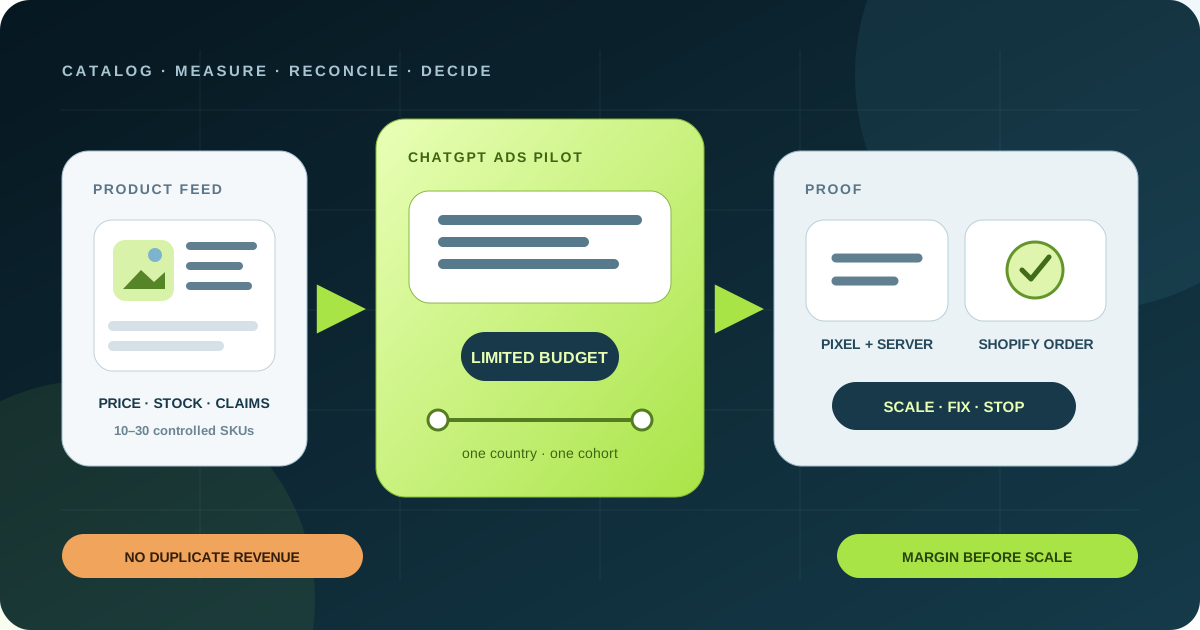
Do not install the app and immediately copy a Meta or Google budget. ChatGPT is a different decision environment, the advertising product is young, and the official app listing already exposes the important dependencies: product data, web and server pixels, conversion events, account permissions and campaign controls. A useful launch plan tests those dependencies before spend obscures the diagnosis.
The short answer: the connector is live; your business case is not
As of 25 September 2026, the Shopify App Store lists OpenAI as the developer and describes a free app that can connect or create an advertiser account, sync the store catalog, build campaigns, set up Shopify pixel and conversion events, and show performance.
Availability still depends on the advertiser account, country, business category and review. Product eligibility is not universal. Account currency and time zone also deserve care because some account-level settings may be difficult or impossible to change later.
The app reduces integration work, but it cannot decide which products have healthy margin, whether a return policy is competitive, or how much attribution disagreement is acceptable. Those remain merchant decisions.
ChatGPT Ads and organic ChatGPT discovery are different channels
| Surface | How products enter | What the merchant controls | Primary evidence |
|---|---|---|---|
| Organic product discovery | For eligible Shopify stores, Shopify Catalog and other discovery methods | Catalog eligibility, product evidence, policies and channel access | Agentic-channel referrals, orders and Shopify reporting |
| ChatGPT Ads | A paid campaign using an ad account and eligible catalog or creative | Budget, objective, targeting, product set and campaign state | Ad impressions, clicks, attributed events and reconciled orders |
A store can appear in product discovery without running ads. Conversely, paying for ads does not repair weak product facts. Keep the two lines separate in analytics and in management reporting. Otherwise an organic order may be credited to paid media, or a paid campaign may appear stronger because total ChatGPT referrals increased at the same time.
Use distinct campaign parameters and preserve the first observable source on the order. Compare platform-attributed purchases with Shopify’s actual paid, cancelled and refunded orders. The existing AI commerce attribution framework is the measurement foundation; this guide adds the channel-specific launch controls.
Pass a four-part readiness gate before spending
| Gate | Minimum pass condition | Stop condition |
|---|---|---|
| Eligibility | Advertiser account, market, business and selected products are accepted | Unsupported category, unresolved verification or policy conflict |
| Catalog | Price, stock, variant, image, URL, policy and core claims match the storefront | Material feed/store mismatch or unavailable destination |
| Measurement | Test journey produces one intended purchase event tied to one order | Missing purchase, duplicate revenue or unexplained currency/value difference |
| Economics | Contribution-margin ceiling and test-loss limit are approved | Team optimizes to revenue while ignoring product cost, fulfilment and returns |
Record an owner and evidence link for every gate. “The app says connected” is evidence of a connection, not of a campaign-ready system.
Audit the catalog as ad creative, not database exhaust
Product-feed ads can draw title, description, price, image and destination URL from the feed. That means merchandising data becomes creative. A technically valid but vague title such as “Model 4 — Blue” gives the system little useful evidence and gives a shopper little reason to click.
Start with a deliberately small product set: 10–30 items with reliable stock, clear differentiation, adequate margin, strong imagery and a low-complexity purchase path. Exclude products with frequent cancellations, volatile lead times, legal uncertainty or a return rate that can erase the gross margin.
For every selected variant, compare the feed with the landing page:
- stable item and variant identifiers;
- specific title, brand and product type;
- current price, currency, sale dates and availability;
- one primary image that represents the exact variant;
- size, material, compatibility and other decision-critical attributes;
- shipping constraints, returns and required legal disclosures;
- a public HTTPS product URL that lands on the purchasable variant.
OpenAI’s product-feed documentation recommends checking ingestion and previewing the products matched by filters before activating a campaign. Matching a product set does not guarantee delivery. It only proves that the selection rule finds the intended items.
Keep identifiers stable. Mark unavailable products out of stock instead of deleting and recreating them. If a price or stock update is delayed, pause the affected product set: an advertisement that promises the wrong price or availability is a trust failure before it is an optimization problem.
Use browser and server evidence without counting a sale twice
The browser pixel measures events on the storefront. The Conversions API sends them from a server and is more resilient to browser restrictions. Using both can improve coverage, but only if the same conversion shares the same event identity.
OpenAI documents the deduplication key as the Pixel ID, event name and event ID. For a completed Shopify order, use one stable value for the browser event_id and server id, and send the same standard event name—normally order_created. Reuse that ID for retries. Do not generate a fresh UUID every time a webhook is retried.
| Test | Expected result |
|---|---|
| Product view | Correct product and variant; no event before required consent |
| Add to cart | Quantity, currency and amount follow the cart state |
| Checkout start | One event for the intended journey, not every checkout repaint |
| Purchase | One event ID across browser and server copies; correct order value and currency |
| Retry | Webhook retry remains idempotent and does not add revenue |
| Refund/cancel | Internal reporting adjusts economics even if ad reporting uses a different lifecycle |
OpenAI’s event stream can confirm recent pixel receipt; it is not the attribution report. Keep three layers distinct: technical delivery, Ads Manager attribution and the Shopify order ledger. A technically received event may not be attributable, and an attributed order may later be refunded.
Never place a Conversions API key in theme code, a client-visible environment variable or logs. Store it server-side. If the official app owns measurement, confirm what it sends before installing another OpenAI pixel tool. Parallel apps can produce duplicate paths that are difficult to diagnose.
Review consent, data access and retention before launch
The Shopify listing says the app can access product data, browsing behaviour, identifiers and customer information, and can edit web and server pixels. Review the live permissions shown during installation; app permissions can change after an article is published.
Shopify’s app pixels run in a strict sandbox and can wait for customer consent according to the store’s privacy configuration. The merchant remains responsible for applicable notice, consent and opt-out requirements. Test four states: consent accepted, rejected, not yet expressed and later changed. Use Shopify Pixel Helper to see whether the pixel is active or awaiting consent.
Minimize the event payload. Send only supported fields required for measurement and matching. Document purposes, processors, retention, lawful basis where applicable, deletion handling and the team members who can access the advertiser account. If legal review is required in the operating market, complete it before production traffic—not after the first complaint.
Design a pilot that can produce a decision
Choose one country, one language, one coherent product group and one primary outcome. A narrow pilot makes feed errors, pricing differences and creative effects visible. Mixing five markets and the entire catalog may produce more data but less understanding.
- Define the hypothesis: for example, high-consideration products with rich specifications will acquire new customers within an agreed contribution-cost ceiling.
- Set the loss limit: approve a maximum spend and calendar end. Do not extend a weak test because “the algorithm is learning” without a pre-agreed rule.
- Select products: use products that can tolerate the target CPA after gross margin, fulfilment, payment fees, expected returns and service cost.
- Choose the objective: begin with clicks only if purchase measurement is not yet trustworthy. Use conversion optimization only after the standard purchase event is validated.
- Hold the landing experience steady: avoid simultaneous redesigns, major discounts and tracking migrations.
- Review quality, not only volume: search intent, product mix, new-customer share, cancellations, returns and support questions matter.
OpenAI’s current product-feed documentation notes that product-feed campaigns support country-level geographic targeting. Check the controls actually available in the account; product and account capabilities can vary during rollout.
Make the scale decision on reconciled contribution
Use Ads Manager for delivery and optimization. Use the order ledger for commercial truth.
| Layer | Metric | Guardrail |
|---|---|---|
| Delivery | Eligible products, impressions, clicks, spend | Serving issues and stale stock |
| Measurement | Event receipt and attributed purchases | Duplicate rate, missing IDs, unexplained platform variance |
| Commerce | Paid orders, net revenue, average order value | Cancellations, refunds and test orders |
| Economics | Contribution margin after ad spend | COGS, discounts, payment, fulfilment, returns and support |
| Customer | New-customer and permitted repeat rate | Small cohorts and incomplete observation window |
Decide among four outcomes: scale the same cohort, fix and retest, narrow to profitable products, or stop. “More traffic” is not a fifth outcome. Record the reason so the next test builds on evidence rather than restarting the debate.
A seven-day controlled launch
- Day 1 — eligibility: confirm account access, market, category, policies, billing and permissions.
- Day 2 — product set: select profitable products and reconcile feed fields against live pages.
- Day 3 — measurement: connect the official app, inspect pixel ownership and map standard events.
- Day 4 — QA: test consent states, browser events, server events, deduplication and order values.
- Day 5 — campaign: create a paused campaign, preview products, URLs, budget, targeting and creative.
- Day 6 — limited release: activate within the agreed loss limit; watch serving and product errors.
- Day 7 — reconcile: compare Ads Manager, Shopify orders, refunds and margin; choose the next review date.
A seven-day launch is not necessarily a seven-day verdict. Products with long consideration or return windows need a longer observation period. The week establishes trustworthy instrumentation and controlled exposure.
Frequently asked questions
Do Shopify products already appear in ChatGPT without ads?
Eligible stores can participate in ChatGPT product discovery through Shopify Catalog without buying ads. Paid ChatGPT Ads are a separate campaign and measurement system.
Does the official Shopify app replace Ads Manager?
No. It brings key creation, catalog, measurement and reporting functions into Shopify, while Ads Manager can expose additional controls and detail. Treat both as views of the same advertiser setup.
Should we use the browser pixel, Conversions API or both?
Both can provide broader coverage. When the same conversion is sent twice, the Pixel ID, event name and shared event ID must align so OpenAI can deduplicate it.
Can we optimize for purchases immediately?
Only after the purchase event is accurate and stable. If order values or deduplication are unproven, a conversion objective teaches the system from unreliable signals.
How much should the first campaign spend?
There is no universal number. Work backwards from product contribution margin, target acquisition cost and an approved test-loss ceiling; use a sample large enough to inform a decision without risking operating cash.
Sources and verification date
Verified 25 September 2026 against the official OpenAI Ads product-feed documentation, Measurement Pixel guide, Conversions API and deduplication guide, and campaign targeting documentation; the ChatGPT Ads Shopify App Store listing; Shopify’s app pixel and privacy guidance and ChatGPT discovery documentation; and McKinsey’s June 2026 European ecommerce analysis. Availability, permissions and ad controls can change; verify the live account before launch.
Rendframe can audit the catalog, implement a privacy-aware event pipeline and build a margin-based pilot dashboard. Start with the product-feed audit method, review AI commerce attribution, or send us a redacted Shopify catalog sample and measurement map.