From 27 September 2026, an EU-facing online shop that sells consumer goods needs more than a warranty paragraph in its terms. It must prominently display the official EU legal-guarantee notice. A separate GARAN label is required only for a qualifying producer durability guarantee.
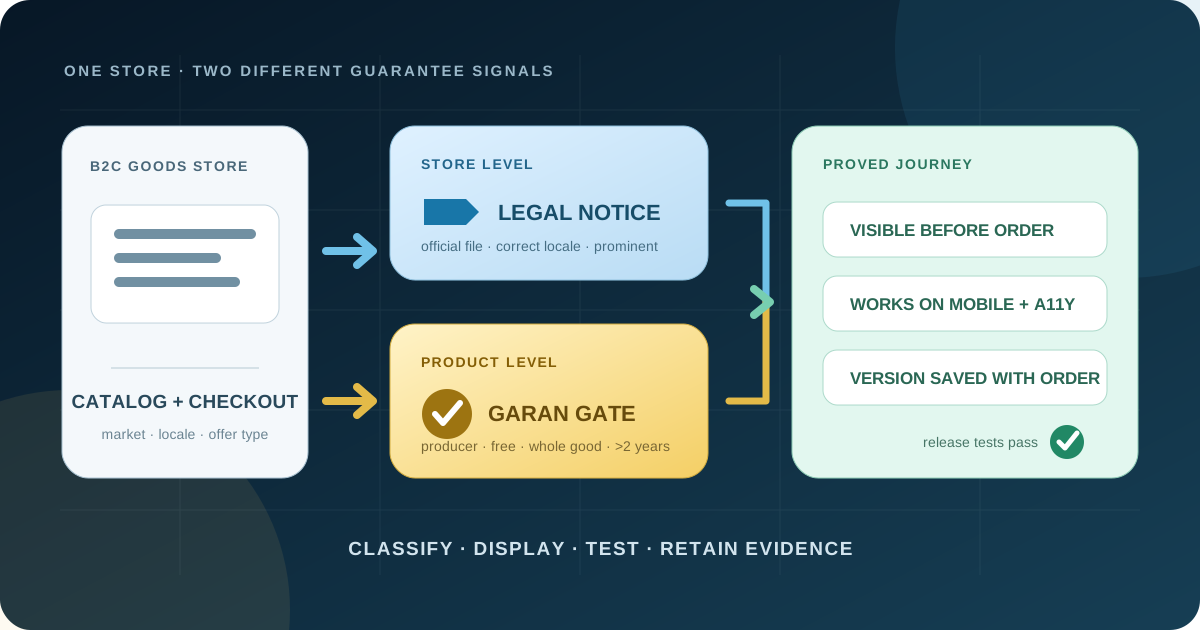
The safe implementation is a small compliance system, not a badge pasted into the footer. Preserve the official artwork, model GARAN eligibility from evidence, place each asset at the right scope, carry it through express checkout and email, and retain proof of what each buyer could see.
The short answer: notice everywhere, GARAN only when qualified
Directive (EU) 2024/825 applies through Member State measures from 27 September 2026. It changes the pre-contract information that traders give consumers. The Commission's Implementing Regulation (EU) 2025/1960 fixes the design and content of two visual assets:
| Asset | When it applies | Scope | Owner |
|---|---|---|---|
| Harmonised legal-guarantee notice | A seller offers consumer goods in the EU | General store reminder | Seller displays the official locale version |
| EU GARAN label | The producer offers a free durability guarantee, covering the entire good, for more than two years, and makes the information available | Specific brand and model | Producer supplies facts; seller displays the qualifying label |
The notice explains the legal guarantee of conformity: at least two years under EU law, potentially longer under national law, with remedies from the seller for non-conforming goods. GARAN communicates an additional producer commitment. They are independent. A three-year guarantee for only the motor, a paid protection plan, or a retailer's own promise does not qualify for GARAN.
This is not just terminology. Showing GARAN on an ineligible product can misstate who is liable, what is covered and for how long. Omitting the general notice because no product has an extended guarantee is the opposite error.
Start with market, contract and product scope
The Directive addresses traders selling to consumers in EU markets. Confirm legal scope and the transposing law for every country you target; national guarantee periods, enforcement and remedies can differ. The EU notice itself points consumers to country information.
Then classify the offer. The harmonised notice concerns goods. Digital content and digital services have a separate reminder obligation, not the goods notice. Goods with digital elements also bring information about the minimum software-update period when the producer makes it available. The same reform adds reparability information: an EU reparability score where applicable, or specified repair and spare-parts information when the producer supplies it.
Build a market matrix before changing templates:
Market | Buyer | Offer type | EU notice | GARAN | Update period | Repair data
DE     | B2C   | appliance  | yes       | if qualified | n/a       | if supplied
PL     | B2C   | smart lock | yes       | if qualified | if supplied | if supplied
FR     | B2C   | SaaS only  | no goods notice | no | if supplied | n/a
B2B    | trade | equipment  | consumer flow not assumed; verify contract
Do not infer legal scope from a shipping-zone toggle alone. Ask counsel to confirm targeted markets, mixed B2B/B2C journeys, marketplaces, refurbished goods, bundles, subscriptions with hardware and old stock. Engineering should encode that approved matrix, not invent it.
Turn supplier claims into a versioned catalog contract
GARAN eligibility is a conjunction, not a duration field. Store the evidence needed to answer every condition:
guarantor_role: producer, retailer or third party;durability_years, with the applicable start and end dates;consumer_price: it must be offered at no additional cost;coverage_scope: entire good or named components;producer_name, brand/trademark and exact model identifier;- producer statement, source document, received date, market and approved reviewer;
- minimum software-update period and source, where relevant;
- reparability score or supplied spare-parts, instructions and restriction information.
Use an explicit state such as garan_eligible = approved | rejected | unknown. Unknown must render no GARAN label. A phrase like “five-year warranty” is insufficient because it does not prove that the producer is responsible, the offer is free or the entire good is covered.
The Directive says sellers need not actively search product websites for the producer's durability-guarantee information. Operationally, that does not justify uncontrolled email attachments. Define one supplier intake route, validate required fields, preserve the source and expire approval when the promise changes. The producer must also provide a commercial-guarantee statement with its identity, claim procedure, covered goods and terms; the consumer must receive it on a durable medium no later than delivery.
Place each asset at its real decision scope
Legal-guarantee notice: use the official file for the storefront language. Online it must be the colour RGB version, complete, legible at the default display size and unedited. The Commission's practical guidance gives several acceptable patterns: a clear “Your legal guarantee rights” trigger in the catalogue, header or checkout, with the full notice available on the first click or hover. It also recommends including the notice in the confirmation email. Provide a clickable link to the same destination as the QR code; do not make keyboard or mobile users scan their own screen.
GARAN label: associate it unambiguously with the qualifying model. Online it must be in colour. The official nested format may expand on the first click, hover or touch. Only its duration, producer brand/trademark and model identifier are editable; keep the Inter typeface and official proportions. Directly before a paid electronic order, the consumer must be clearly reminded of the applicable durability-guarantee information.
A footer-only link is fragile because it can disappear inside an app browser or express checkout. A product-only notice may vanish when a shopper enters through a collection and buys through a drawer. Map every path that can create a contract: standard PDP, quick add, cart drawer, checkout, accelerated wallet, marketplace, mobile app and order confirmation.
A maintainable implementation pattern
- Keep official assets immutable. Download them from the Commission, store the source URL and version, and checksum the production files. Do not recreate the QR code or translate the text yourself.
- Resolve locale deliberately. Map each supported EU storefront language to an official notice. Define what happens when the interface language is Ukrainian or Russian, which are not official EU notice editions: show the appropriate official market language or another counsel-approved version without altering it, while surrounding help copy can remain localized.
- Compute product eligibility server-side. Render GARAN only from approved structured data. Do not parse marketing copy at runtime.
- Separate content from placement. One component displays the store-level notice; another accepts an approved guarantee record and renders the product label. This prevents a global banner from claiming every SKU qualifies.
- Freeze evidence with the order. Record asset version, locale, market, product guarantee record and timestamp. Preserve the guarantee statement delivered to the customer.
- Monitor upstream changes. Supplier feed updates that remove full-product coverage or shorten the term should open a review, not silently leave an old label live.
Accessibility still applies. Triggers need meaningful accessible names, keyboard operation, visible focus and a mobile interaction that does not depend on hover. The full graphic needs useful alternative text or adjacent text conveying its purpose, while the official image itself remains visually unchanged.
Release tests that catch the expensive mistakes
| Test | Pass condition |
|---|---|
| Eligible model | Correct duration, producer and model; colour label; full view opens in one interaction |
| Component-only guarantee | No GARAN label; ordinary guarantee terms remain clear |
| Paid protection plan | No GARAN label and no visual confusion with the EU label |
| Locale and market | Official notice matches the approved market-language rule; QR and link resolve |
| Express checkout | Required information remains visible before order despite skipped pages |
| Notice and durable guarantee statement survive common clients and blocked images | |
| Mobile and accessibility | No clipping; touch, keyboard, focus and screen-reader path work |
| Evidence | Order audit can identify the exact notice and guarantee version shown |
Add screenshot or DOM assertions to every storefront release. Crawl all sellable SKUs and fail the build if a GARAN label appears without an approved record, an approved label is absent, editable fields are blank, or a notice asset is modified. Test cached pages after supplier-data changes.
A six-day implementation plan
- Day 1 — scope: confirm markets, consumer flows, goods and digital offers, marketplaces and local-law owners.
- Day 2 — evidence: inventory guarantees and reject unsupported GARAN candidates; request structured data from producers.
- Day 3 — assets: download official notice and GARAN files, map locales and document immutable fields.
- Day 4 — journeys: implement store-level notice, model-level label, pre-order reminder and confirmation evidence.
- Day 5 — tests: cover eligible, ineligible and unknown products across desktop, mobile, keyboard and express payment.
- Day 6 — release: obtain legal and merchandising sign-off, deploy with screenshots, checksums, rollback and a supplier-change owner.
This is an engineering and content implementation guide, not legal advice. Directive provisions are implemented through national law, and only the Court of Justice can authoritatively interpret EU law. Confirm country scope and enforcement with qualified counsel.
Frequently asked questions
Does every product need a GARAN label?
No. It applies only when the producer offers a durability guarantee at no extra cost, covering the entire good, for more than two years, and makes that information available. The general legal-guarantee notice is the broader seller obligation.
Can we design our own smaller badge?
No. Use the official files. The notice is not editable; the GARAN label allows only the specified duration, producer brand/trademark and model identifier fields. Online versions must be in colour.
Must the full notice be permanently visible on every product page?
The law requires prominent pre-contract information. Commission guidance allows a clear trigger whose full notice appears on the first click or hover, including in the catalogue, header or checkout. Validate the chosen pattern under applicable national law.
What if the manufacturer guarantees only the battery?
Do not use GARAN. The qualifying durability guarantee must cover the entire good. You may describe the battery guarantee clearly without presenting it as the EU GARAN commitment.
Do software-update and repair details belong in the same project?
Yes. They arise from the same reform and often use the same supplier and catalog pipeline. Keep them as separate fields and display rules; do not squeeze them into the official notice or label.
Sources and verification date
Verified 21 September 2026 against Directive (EU) 2024/825, Implementing Regulation (EU) 2025/1960, the EU's business guidance on the notice and GARAN label, the Commission's official assets and practical display guidelines, and its current implementation hub and Q&A.
Rendframe can turn the approved legal matrix into catalog fields, storefront components, checkout controls, email evidence and regression tests. Pair this work with the GPSR product-page checklist and ecommerce accessibility audit, or send us one storefront, market list and anonymized guarantee sample.