Since 31 July 2026, “right to repair” in the EU is no longer only a product-design discussion. It changes what sellers say when a consumer reports a defect, who must accept certain post-guarantee repair requests, and what service information needs to be available online.
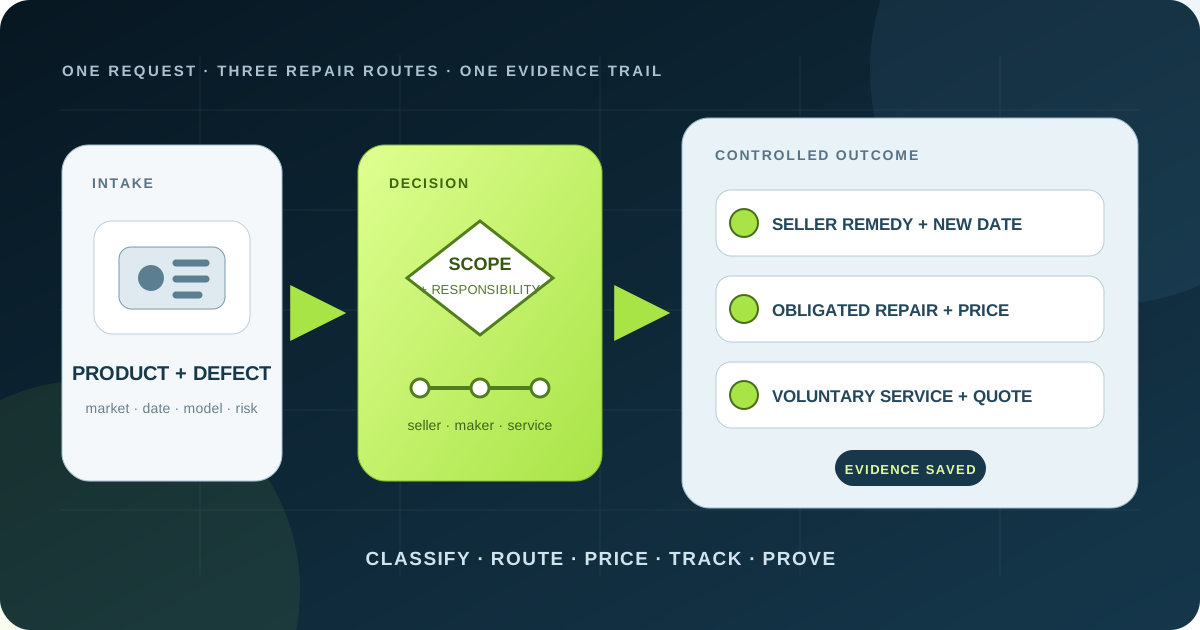
The practical fix is not a new “repairs” page. Build one intake that classifies the product, market, purchase date, defect and responsible operator; then route it to the correct legal and operational path. Otherwise support agents will mix free remedies with paid repairs, reset the wrong deadline or send a customer to a manufacturer that is not responsible.
The short answer: separate seller liability from the manufacturer’s repair duty
Directive (EU) 2024/1799 required Member States to apply transposing measures from 31 July 2026. It creates two operationally different changes.
| Situation | Primary counterparty | Commercial rule | System consequence |
|---|---|---|---|
| Lack of conformity within the seller-liability period | Seller | Consumer is informed about repair versus replacement; choosing repair extends the liability period once by 12 months, unless national law gives more | Claims workflow must show the choice and recalculate the deadline |
| Defect outside seller liability for a product covered by EU repairability rules | Manufacturer, or the EU operator in the statutory sequence | Repair must be offered free or at a reasonable price and within a reasonable time, unless impossible | Service routing needs product-scope, operator and price information |
The second route is not a free lifetime warranty. The consumer may have to pay. It is also not a universal duty covering every item in a catalogue. It follows the products and extent of repairability requirements in Annex II of the Directive. Treating all three ideas as “warranty” creates misleading copy and expensive support errors.
Map the responsible role before writing the interface
As of the current consolidated text, Annex II covers household washing machines and washer-dryers, dishwashers, refrigerating appliances, electronic displays, welding equipment, vacuum cleaners, servers and data-storage products, mobile and cordless phones, slate tablets, household tumble dryers, and goods incorporating light-means-of-transport batteries. The list can grow when new EU repairability acts are added.
The obligation normally sits with the manufacturer. If that manufacturer is outside the EU, the sequence moves to its authorised representative, then the importer, and then the distributor if the earlier roles do not exist. The responsible operator may subcontract the actual repair but remains responsible for the obligation. A marketplace, reseller and brand owner therefore should not guess responsibility from the logo shown on a product page.
Create a versioned scope register for each model and target country:
market | model | product class | EU repair act | obligated operator | valid from/to
DE     | X100  | smartphone    | 2023/1670     | EU representative  | 2026-07-31/—
FR     | D42   | dishwasher    | 2019/2022     | manufacturer       | 2026-07-31/—
PL     | L9    | desk lamp     | not listed    | ordinary service   | reviewed 2026-09
Do not copy this list into a permanent FAQ and forget it. Keep the legal source, review date and owner with every mapping. Confirm national transposition, longer consumer protections and enforcement with counsel in the countries you serve.
Route one request into three clearly named services
1. Seller remedy for a non-conforming good
The customer contacts the seller. Before providing the remedy, the seller must inform the consumer about the right to choose between repair and replacement and about the possible extension if repair is chosen. The choice is still subject to the existing rules on impossibility and disproportionate cost. A successful repair extends the seller-liability period once by 12 months; Member States may provide longer periods.
This amendment applies to sales contracts concluded after 31 July 2026. Keep contract date as a routing field rather than replacing the policy for every historical order.
Store the notice version, options presented, consumer choice, repair completion date and new liability deadline. Do not merely add 365 days to the order date. The Directive adds the extension to the relevant liability period, while national starting points and longer rules can differ.
2. Statutory repair outside seller liability
For an in-scope product, the obligated operator must repair on request unless repair is impossible. The service may be free or charged at a reasonable price and must be completed within a reasonable period after the operator has the good, receives it, or is given access to it. A loan item may be offered; where repair is impossible, a refurbished item may be offered.
The operator must not reject an in-scope repair solely because someone else repaired the item earlier. Nor may it block compliant original, second-hand, compatible or 3D-printed parts through unjustified contractual, hardware or software techniques. Product-safety and intellectual-property rules still matter.
3. Voluntary repair service
A retailer or independent workshop may accept products beyond the mandatory scope. Keep this route, its prices and promises separate. The Directive’s standard repair form can be useful here, but using it does not turn an ordinary service into a manufacturer obligation.
Build the repair record around the product, not the ticket subject
A useful intake needs more than “device broken.” Capture:
- customer market, contract date, seller and order reference;
- brand, exact model, serial number and product category;
- defect description, when it appeared, safety symptoms and uploaded evidence;
- seller-liability status and any earlier remedy or extension;
- Annex II mapping, applicable product act and duration of the repairability requirement;
- manufacturer, authorised representative, importer and distributor records;
- diagnostic consent and disclosed fee, quote version and validity;
- handover method, shipping chain, repairer, parts, status and promised completion;
- outcome, completion date, loan or refurbished item and retained communications.
Use explicit states such as seller_claim, obligated_repair, voluntary_service and manual_review. Unknown scope must go to review, not silently become a paid service. Safety signals—swollen battery, smoke, overheating or damaged mains wiring—need a separate instruction before any shipping label is issued.
Design a customer journey that does not make the law the customer’s job
- Identify: accept an order lookup but also support gifts, second-hand ownership and post-guarantee requests without the original store account.
- Triage: ask plain-language questions, then resolve the legal route server-side. Do not ask “Is this an Article 5 repair?”
- Explain: name the responsible party, whether this is a seller remedy or paid repair, likely costs, diagnostic fee and next action.
- Confirm: capture an informed repair/replacement choice where the seller-liability route applies.
- Handover: offer accessible collection, drop-off or on-site instructions; preserve custody events and hazardous-goods restrictions.
- Track: show a real status and target, not a generic “processing” label. Escalate ageing cases before the reasonable-time promise fails.
- Close: record work performed, parts, completion and the recalculated liability deadline; provide the durable record to the customer.
Information about the obligated operator’s repair services must remain freely accessible, clear and comprehensible for the whole duration of the obligation. Consumers must also be able to access indicative prices for typical repairs through a free-access website. The Directive’s recitals allow service information through a prominent website, a Digital Product Passport or the point of sale. A public page should therefore be indexable and accessible, while the claim itself remains private.
Use the European Repair Information Form deliberately
The standard form is voluntary for repairers. If provided, it must be on a durable medium, free of charge and delivered before the customer is bound. A diagnostic service may be charged when needed, but its cost must be disclosed before the consumer requests it.
The form identifies the repairer and product, defect, proposed work, price—or calculation method and maximum—completion time, loan item, handover place, ancillary services and costs, and validity period. Its conditions cannot be changed for at least 30 calendar days. If accepted while valid, the repairer must perform under those conditions.
Generate a locked PDF or similarly durable document from structured quote data; do not render a live web page whose price can change later. Save the template version and input snapshot. The form can satisfy several EU pre-contract information duties when complete and accurate, but local tax, cancellation, service and accessibility requirements still need review.
Controls that catch costly repair failures
| Test | Pass condition |
|---|---|
| Covered model, external manufacturer | Routes to the correct representative, importer or distributor in sequence |
| In-guarantee choice | Repair/replacement information is shown and the 12-month extension is applied once after repair |
| Prior independent repair | No automatic rejection solely because the device was opened elsewhere |
| Unknown product scope | Manual review; no unsupported promise or fee |
| Diagnostic fee | Price disclosed before consent and preserved in evidence |
| Quote expiry | Accepted form remains unchanged for its validity period |
| Safety defect | Unsafe shipping route is blocked and specialist instructions appear |
| Accessibility and locale | Keyboard, screen reader, mobile and customer-language flows complete |
Measure first response, correct-route rate, quote acceptance, repair cycle time, parts wait, repeat defect, abandoned intake and complaint rate. Do not reward agents only for closing tickets quickly; that can hide misrouting. McKinsey’s 2025 research on industrial aftermarket services found quality, cost and speed were the leading buying factors and identified poor parts availability and slow turnaround as major concerns. The research is B2B, so it does not prove consumer behaviour, but it supports a sound operational inference: transparent repair promises fail without parts and capacity data.
A seven-day implementation plan
- Day 1 — scope: list EU markets, product classes, seller entities and service partners; obtain national-law review.
- Day 2 — responsibility: resolve manufacturer, representative, importer and distributor for every covered model.
- Day 3 — policy: approve route names, price rules, diagnostic fees, safety exceptions and escalation owners.
- Day 4 — data: add the scope register, remedy history, deadlines, quote snapshots and custody events.
- Day 5 — journey: ship public repair information, guided intake, durable form and status tracking.
- Day 6 — tests: run covered, uncovered, post-guarantee, prior-repair, repeat-repair, dangerous-device and locale cases.
- Day 7 — release: train support, enable monitoring, sample live cases and set a monthly Annex II review.
This is an implementation guide, not legal advice. The Directive operates through national measures, and product-specific repairability acts define the extent and duration of repair duties. Use qualified counsel for country and product decisions.
Frequently asked questions
Does the EU right to repair mean every repair is free?
No. A seller remedy for a lack of conformity is free under the applicable guarantee rules. The separate manufacturer duty outside seller liability may be free or offered at a reasonable price.
Does it cover every product sold online?
No. The manufacturer repair duty follows goods and the extent of EU repairability rules listed in Annex II. The list currently includes specified appliances, displays, phones, tablets, servers, data-storage products and certain other goods.
Must a repairer use the European Repair Information Form?
No. It is voluntary. If used, it must be complete, provided on a durable medium, normally free, and its conditions must remain unchanged for at least 30 days.
Can a manufacturer refuse because an independent workshop repaired the product?
Not for that reason alone when the product falls within the Article 5 duty. Refusal may still follow if repair is impossible or another legitimate product-safety or legal issue applies.
What changes for an online retailer?
The claims flow must explain repair versus replacement and the possible extension before a remedy. Retailers that are also manufacturers, representatives, importers, distributors or repairers may have additional routing and service-information duties.
Sources and verification date
Verified 22 September 2026 against the consolidated Directive (EU) 2024/1799, the European Commission’s application-date summary, the Council’s right-to-repair explainer, the consolidated Sale of Goods Directive, and McKinsey’s 2025 aftermarket-service research.
Rendframe can turn the approved scope matrix into a guided intake, product-role registry, service integrations, durable quotes, deadline logic and regression tests. Start with the EU guarantee notice and GARAN checklist, then send us one product family, target-market list and anonymized repair case.