Google is moving some existing Search campaign settings into AI Max in September 2026. The practical risk is not the label change. It is letting broader matching, generated text, landing-page selection, and conversion bidding interact without a verified control plan.
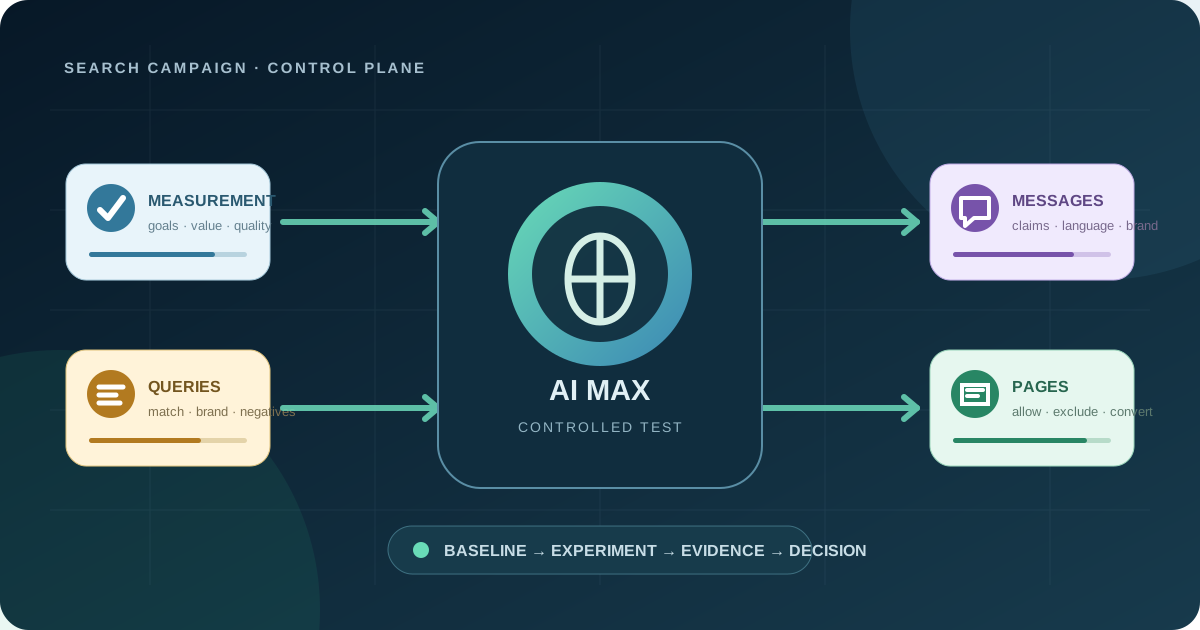
Before or immediately after the upgrade, take a campaign-level snapshot and audit five things: conversion truth, query expansion, generated messages, eligible landing pages, and reporting. Keep proven controls, test added reach against business outcomes, and change one material variable at a time. AI Max is an optimization layer for Search campaigns, not a new campaign type and not a reason to rebuild the account blindly.
What the September 2026 AI Max change actually means
Google's current help pages say that, starting in September 2026, Search campaigns using the campaign-level broad-match setting will be automatically upgraded to AI Max. The same applies to campaigns using text customization, previously called automatically created assets. Google postponed the automatic migration of Dynamic Search Ads until February 2027.
This is important because “upgraded to AI Max” does not mean every campaign should emerge with every AI Max feature serving in the same way. Google's announcement says migrated settings are configured to mirror the legacy setup. Treat the interface label as packaging and verify the post-migration state per campaign. Never infer an account's behavior from a banner alone.
AI Max can combine search-term matching, text customization, Final URL expansion, brand settings, location-of-interest controls, URL inclusions and exclusions, and new reporting. Search-term matching can use broad-match, asset, and landing-page signals. Text customization can create headlines and descriptions from the domain, page, existing ads, and keywords. Final URL expansion can replace the submitted destination with another relevant page on the same domain.
Build an affected-campaign register first
Export every enabled and paused Search campaign. Record whether it uses the campaign-level broad-match setting, legacy automatically created assets or current text customization, DSA ad groups, Smart Bidding, brand lists, negative keywords, page feeds, tracking templates, pinned responsive-search-ad assets, and multiple domains or languages.
| Signal | Why it matters | Decision |
|---|---|---|
| Campaign-level broad match | September 2026 migration; keyword-priority logic changes | Audit exact-keyword coverage and query reports |
| Text customization | Moves under AI Max; generated assets remain reviewable | Define prohibited terms and review owner |
| DSA | Separate automatic migration starts February 2027 | Do not confuse the two deadlines |
| Final URL expansion | Google may choose another page and generate matching copy | Approve or exclude site sections |
| Pinned RSA assets | Pinning is not respected when an expanded final URL serves | Turn expansion off where exact copy is mandatory |
Add an accountable owner, daily budget, bidding strategy, primary goal, market, language, business constraint, and last review date. Screenshot or export current settings before changing them. This record is both a rollback reference and the denominator for checking whether all affected campaigns were reviewed.
Save a baseline that can answer a business question
Do not judge the migration by click-through rate alone. Save at least the previous four to eight comparable weeks by campaign: spend, impressions, clicks, conversions, conversion value, cost per qualified conversion, value per cost, new-customer share where available, and lag from click to conversion. Segment brand and non-brand demand. Annotate promotions, outages, budget limits, consent changes, seasonality, and landing-page releases.
Export search terms, landing pages, and served assets. Group terms by business intent: own brand, competitor, exact service or product, research, support, jobs, existing-customer navigation, and irrelevant. A blended CPA can improve while qualified demand deteriorates if cheap micro-conversions or branded traffic hide poor expansion.
Choose one primary decision metric and two guardrails before the test. For example: qualified-lead CPA as the decision metric; sales-accepted rate and brand-compliance incidents as guardrails. For ecommerce, use gross-margin-aware conversion value when reliable rather than raw order count.
Automation is only as good as the conversion truth
Review every conversion action used for bidding. A primary goal should represent business value: a paid order, qualified enquiry, booked consultation, or another outcome the team genuinely wants more of. Page views, chat opens, scrolls, and unverified form starts belong in observation unless they are deliberately modeled and economically justified.
- Submit one transaction or lead identifier so refreshes and retries do not create duplicates.
- Pass order value, currency, refunds, cancellations, and lead-quality updates where the stack supports them.
- Test consent behavior, cross-domain checkout, call tracking, CRM imports, attribution windows, and timestamp/time-zone handling.
- Compare Ads totals with commerce or CRM outcomes by day and source. Explain material gaps before increasing automation.
- Keep goal changes separate from the AI Max test; changing both destroys the baseline.
Google's broad-match campaign setting requires conversion-based Smart Bidding. That dependency makes noisy goals especially costly: the system can efficiently acquire more of the wrong signal. If the business cannot distinguish a qualified result from a cosmetic event, fix measurement before judging query expansion.
Control query expansion without pretending keywords disappeared
AI Max search-term matching is enabled at ad-group level and can be switched off there. Keep tightly themed ad groups, explicit negatives, brand settings, and clear landing pages. Use the search-terms report to compare “AI Max expanded matches” with “AI Max landing page matches,” then inspect the combined search term, headline, and destination journey.
One migration detail deserves a separate check. Under the old campaign-level broad-match setting, broad keywords could be prioritized as if an exact version were present. Google says this special priority no longer applies after moving to AI Max. If account routing depends on a particular exact keyword winning, add and test an exact-match copy rather than assuming the old path remains. Do not convert the only broad keyword merely to preserve priority; conversion removes its historical keyword statistics.
Create negative-keyword rules from meaning, not anxiety. Exclude jobs, support, free downloads, unrelated locations, prohibited products, and other provably unsuitable intent. Review new queries in context with the served headline and page. A surprising phrase may still be profitable; a familiar phrase can be wasteful when it lands on the wrong offer.
Treat generated text as a publishing system
Text customization can produce additional headlines and descriptions. Give it clean source material: accurate landing pages, current offers, clear product names, and existing ads that express the approved proposition. Then write explicit constraints for claims the system must not invent or imply.
- List protected trademarks, regulated claims, superlatives, price promises, guarantees, delivery times, and competitor names.
- Separate languages by coherent campaign and page structure. Do not rely on one mixed-language page to teach brand voice.
- Use AI Max text guidelines, term exclusions, brand inclusions or exclusions, and account-level negatives where available.
- Review the asset report's “Added by” column and served combinations. Remove unacceptable Google-customized assets.
- Keep legal or contractual sentences in a path where exact wording is enforced. Generated text is unsuitable when variation itself is prohibited.
Remember the interaction with Final URL expansion: if Google chooses a different page, pinned RSA assets may not serve. If a mandatory disclaimer, price qualifier, or carefully approved headline must appear every time, turn off Final URL expansion for that campaign rather than trusting pinning.
Define the landing-page perimeter
Final URL expansion is useful only when the eligible site area is commercially coherent. Crawl the public domain and classify every indexable page as allowed, conditionally allowed, or excluded. Common exclusions include privacy and legal pages, careers, support articles, account areas, internal search, expired promotions, out-of-stock-only collections, staging remnants, and pages for another market or language.
Check allowed pages for successful status, mobile usability, current price and availability, clear conversion action, working forms or checkout, analytics, consent behavior, and consistent language. A fast campaign cannot rescue a broken destination. Use Rendframe's Core Web Vitals audit for performance triage and the Merchant Center feed audit when product facts differ between ads, page, feed, and checkout.
Use URL exclusions for pages that must never receive ad traffic. Use inclusions to guide relevant site areas where supported. Re-crawl after releases: automation makes a newly published but unsuitable page eligible faster than a quarterly manual audit will notice it.
Run a test, not an uncontrolled launch
Where the account is eligible, Google's AI Max experiment splits traffic inside the existing campaign between control and trial, reducing copy and synchronization errors. Freeze material changes to budget, goals, promotions, geography, and landing-page architecture during the comparison where practical.
- Validate conversion actions and save the baseline.
- Set the AI Max features and controls being tested. Write down the hypothesis.
- Choose the decision metric, guardrails, traffic split, minimum duration, and stop conditions before launch.
- Let normal conversion lag mature. Google's general experiments guidance recommends at least four to six weeks when results remain undecided; AI Max reporting guidance also says to allow about two weeks of learning before optimization changes.
- Evaluate incrementality, not just the AI Max rows. Compare total campaign value, query mix, lead quality, landing pages, and brand incidents.
A result can be “keep only part.” Search-term matching may add valuable demand while Final URL expansion sends users to weak pages; generated text may help one language and violate another market's constraints. AI Max exposes separate controls, so use them.
Operate the campaign after migration
Keep a decision log: setting, date, owner, hypothesis, expected effect, observed effect, and rollback. Alert on sudden conversion-rate changes, new destinations, high-spend queries without qualified outcomes, generated-asset removals, and CRM quality deterioration. The goal is not to maximize the number of AI Max features switched on. It is to expand profitable reach inside boundaries the business can verify.
Frequently asked questions
Is AI Max a new Google Ads campaign type?
No. Google describes it as an optimization layer for existing Search campaigns. Its controls can affect matching, generated text, landing pages, brands, locations, and reporting.
Which campaigns auto-upgrade in September 2026?
Google currently names Search campaigns using the campaign-level broad-match setting and campaigns using text customization, formerly automatically created assets. Verify notices and settings in the actual account.
Are Dynamic Search Ads migrating at the same time?
No. Google updated the DSA automatic-upgrade schedule to begin in February 2027. DSA deserves a separate inventory and migration test.
Can AI Max send traffic to a different landing page?
Yes, when Final URL expansion is enabled. Google can select another relevant page on the same domain and create matching text. Use exclusions, inclusions, page quality controls, or turn expansion off.
Should a small business enable every AI Max feature?
No universal setting is correct. Start from trustworthy conversions and commercially sound pages, test incremental value, and keep only the features whose outcome and risk you can measure.
Sources and verification date
Verified 17 September 2026 against Google's official guidance on the revised migration schedule, how AI Max works, campaign-level broad match, text customization, Final URL expansion, AI Max reporting, and AI Max experiments. Features, eligibility, labels, and schedules can change; confirm the current account notice before acting.
Rendframe can audit conversion tracking, landing-page eligibility, multilingual message constraints, and the data path from Google Ads to CRM or checkout, then build monitoring around the approved setup. Explore ecommerce systems or product engineering, or send us one anonymized campaign export and its conversion map.