Google now supports local-business queries in two search-result features shown to people in the European Economic Area: an aggregator unit for directories and comparison services, and a supplier unit for the businesses that provide the service directly.
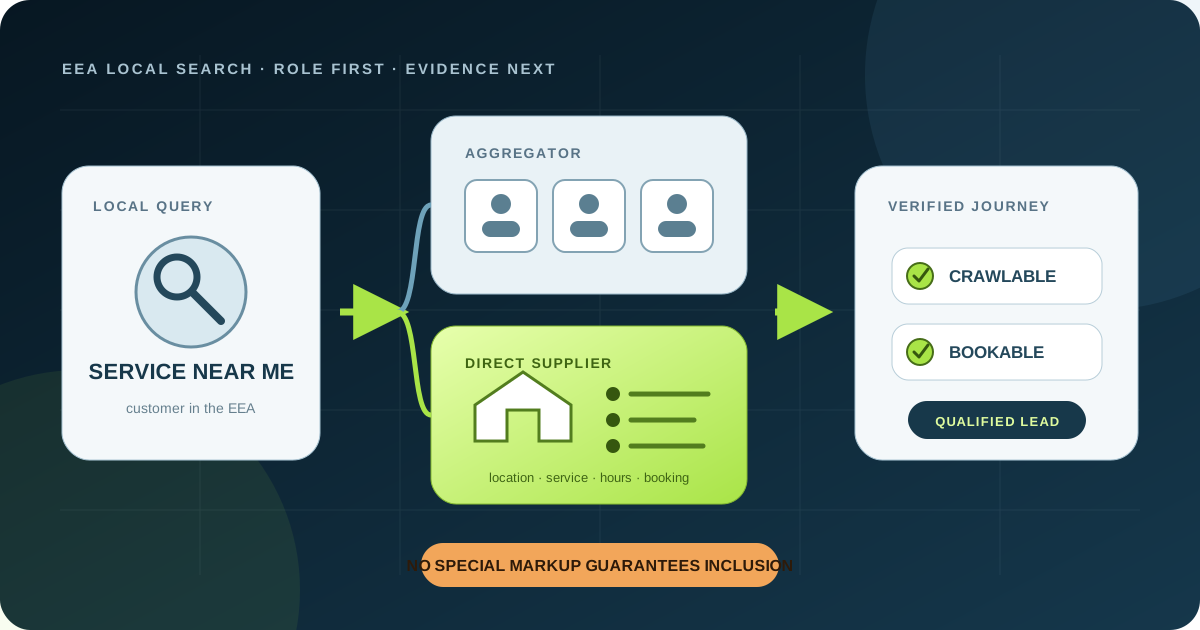
This is not a new badge to install or a ranking trick. Google says a direct provider can be eligible from information already available through web crawling. The useful response is therefore to make each real location, service and booking path understandable, consistent and measurable—not to create hundreds of thin city pages or invent structured data.
The short answer: EEA local results can now show two parallel units
On 18 September 2026, Google updated its Search Central documentation to add local-business queries to the aggregator unit and supplier unit. These features are available to users in EEA countries. A supplier unit is shown alongside an aggregator unit and only appears when the aggregator unit appears.
| Role | Typical business | Participation path |
|---|---|---|
| Direct supplier | One hotel, clinic, restaurant, workshop, shop or service-area provider such as a plumber | No additional feed is required beyond crawlable website data; an optional supplier feed may enhance results |
| Aggregator | Directory, marketplace, comparison site, OTA or vertical search service listing multiple providers | Apply as a Vertical Search Service, meet quality requirements and provide a direct feed or API |
| Lead-generation site | A site that presents contractors but does not itself perform the work | Do not assume “supplier”; document who contracts with the customer and assess the aggregator route |
Google does not say that every local query will trigger either unit, that eligibility guarantees inclusion, or that a new schema property controls it. The feature also concerns the searcher’s location: serving an EEA audience matters. A company based elsewhere does not become eligible merely by translating a page or naming an EU city.
Resolve the commercial role before touching SEO
A marketplace and the businesses listed on it need different systems. The aggregator controls inventory from many providers, freshness, duplicate handling and landing-page quality. The supplier controls its own service, location, availability and conversion journey. Blurring the roles produces misleading pages and the wrong implementation plan.
For every domain and location, answer five questions:
- Who signs the contract or accepts the booking from the customer?
- Who performs the service and carries the licence, insurance or professional responsibility?
- Does the site represent one provider, a group under one brand, or many independent providers?
- Are prices, hours and availability controlled directly or imported from partners?
- Which EEA countries and languages are genuinely served?
If one brand operates several branches, define each real branch as a location within the direct-provider system. If a platform compares unrelated businesses, investigate the aggregator application and Local Point of Interest feed. Do not duplicate an aggregator catalogue into pseudo-local supplier pages.
Run an evidence audit across website, profile and operations
The new supplier unit raises the value of owned website data, but it does not replace the Google Business Profile. Google’s own local-ranking guidance still describes relevance, distance and prominence as the main factors. Audit the two surfaces together.
| Evidence | Pass condition | Common failure |
|---|---|---|
| Identity | Legal or trading name, primary category, phone and website agree | Keyword-stuffed profile name or different brands across directories |
| Location | Real address or service area, country, branch and map details are accurate | Virtual offices, copied city pages or hidden address contradictions |
| Service | Each priority service has a useful page explaining scope, exclusions and delivery | One generic services page or pages made only by swapping city names |
| Hours and availability | Normal, holiday and emergency hours match the operational system | “Open now” data disagrees with the booking or phone team |
| Conversion | Call, form, booking, directions and quote paths work on mobile | JavaScript-only controls, dead calendars or a form with no confirmation |
| Trust | Reviews, licences, team, policies and prices are attributable and current | Self-authored ratings marked as customer reviews |
Use one canonical record for branch name, address, service area, phone, hours and booking URL. Feed it to the website, profile-management process, CRM and any legitimate directories. The goal is not mechanical character-for-character repetition: it is one factual source that prevents stale contradictions.
Build pages that answer a local customer’s decision
A direct supplier should normally have one indexable page for each real location and separate service pages where the customer need, evidence or conversion path materially differs. A useful location page answers what is available there, who provides it, where the boundary lies, when it is available, what it costs or how pricing works, and what happens after contact.
For a physical branch, include the complete address, directions, accessible entrance or parking information where relevant, branch-specific hours, telephone, images, services, booking route and local policies. For a service-area business, state the genuine operating area without publishing a fake office. Explain travel charges, response windows and exclusions.
Make these facts present in visible page content and ordinary HTML links. Google’s link guidance says crawlable links generally use an <a> element with an href. A map pin, tab or JavaScript click handler must not be the only route to a location page. Each important page should be linked from at least one other page, included in the sitemap, return a stable 200 response and remain usable without login.
Avoid three tempting shortcuts:
- Doorway pages: do not generate “service in city” pages where only the place name changes and no distinct operation exists.
- Unsupported superlatives: “best”, “number one” and fabricated availability do not make the entity clearer.
- Automatic translation without ownership: publish a locale only if enquiries can be handled and key facts stay synchronized. Use separate URLs and appropriate language alternates.
Use Business Profile and LocalBusiness schema as corroboration
Claim and verify each eligible Google Business Profile, choose the most specific truthful primary category, and keep hours, contact data, service area, photos and booking links current. Google explicitly says complete and accurate profile information is more likely to appear for relevant local searches; nobody can pay Google for better organic local ranking.
Add LocalBusiness structured data to the page that visibly describes each location. Use the most specific supported subtype, an address for a genuine customer-facing location, telephone, url, coordinates where appropriate and openingHoursSpecification. Connect the entity consistently to the parent Organization. Validate the rendered output and compare it with the words a customer sees.
Schema is corroborating data, not a licence to add hidden claims. Google recommends review and aggregate-rating properties for sites that collect reviews about other local businesses, not for marking up a business’s self-serving testimonials. Do not add a postal address to a service-area page if customers cannot visit it.
Measure the change without pretending Search Console names the unit
Google’s supplier-unit documentation does not announce a dedicated Search Console appearance filter. Establish a baseline instead of labelling every movement as a feature win.
- Record 28 days of clicks, impressions, CTR and landing pages for non-brand local queries.
- Segment by EEA country, device, location URL and query family: service + city, service + “near me”, brand + branch.
- Track Business Profile calls, website clicks, directions and bookings separately from website organic sessions.
- Pass branch and service identifiers into forms and bookings; connect qualified leads and revenue in the CRM.
- Annotate profile, page, schema and feed changes. Compare like-for-like periods and allow for seasonality.
Search Console omits some anonymized queries and average position is not a literal rank for every user. Google notes that results vary by time, place, device and search history. Focus on trends in qualified clicks, calls and bookings rather than screenshots from a manually chosen location.
A fourteen-day implementation plan
- Days 1–2 — role and market: classify supplier versus aggregator, list actual EEA markets, branches, service areas and supported languages.
- Days 3–4 — source of truth: reconcile website, Business Profile, booking system, CRM and directories; assign an owner and update cadence.
- Days 5–7 — pages: repair or create genuine location and service pages with crawlable navigation, clear scope and working conversion routes.
- Days 8–9 — entity data: verify profiles, implement location-level LocalBusiness markup and validate rendered HTML.
- Days 10–11 — quality: test mobile contact, accessibility, language routing, hours, holiday exceptions and booking confirmation.
- Days 12–14 — measurement: create the Search Console baseline, tag leads by location and publish a change log.
Aggregators need a parallel programme: confirm VSS fit, submit Google’s interest form, prepare a Local Point of Interest feed, define freshness and deletion rules, and ensure each result lands on a useful detail page. That is product and data operations—not a one-off SEO ticket.
Frequently asked questions
Do I need to submit a feed as a local business?
Not necessarily. Google says direct suppliers need no extra data beyond what web crawling can access, although a supplier feed can enhance results. Aggregators must follow the application and feed or API route.
Does LocalBusiness schema guarantee a supplier-unit listing?
No. It helps Google understand visible business facts, but Google offers no inclusion guarantee and documents no special supplier-unit property.
Is a Google Business Profile enough?
No. Keep it accurate, but Google explicitly says the supplier path can use crawlable website data. Treat the profile and website as two representations of the same operation.
Can a Ukrainian company appear?
Potentially, when it genuinely serves users in the EEA as a direct provider. A Ukrainian address or translated page alone does not satisfy that condition; document the real branch or service operation and its customer journey.
Should we create a page for every city?
Only where the service, team, location, evidence or customer journey is genuinely distinct. Mass-produced city pages are not useful evidence and can dilute the pages that matter.
Sources and verification date
Verified 24 September 2026 against Google’s official Search documentation changelog, supplier unit requirements, aggregator unit requirements, local ranking guidance, LocalBusiness structured-data guide, crawlable link guidance, and Search Console performance documentation. Strategic context was checked against McKinsey’s 2026 B2B Pulse report, which places supplier websites and web search among the leading discovery channels.
Rendframe can turn this into a branch-level audit: entity data, crawlability, local pages, schema, multilingual routing and lead measurement in one release plan. Start with the initial-HTML schema audit, use the SEO migration checklist if URLs are changing, or send us one domain and the EEA locations you actually serve.