An MCP server can give an AI assistant access to email, files, databases, source code, payments, or production systems. Installing one is therefore closer to onboarding a privileged integration than adding a harmless chat feature.
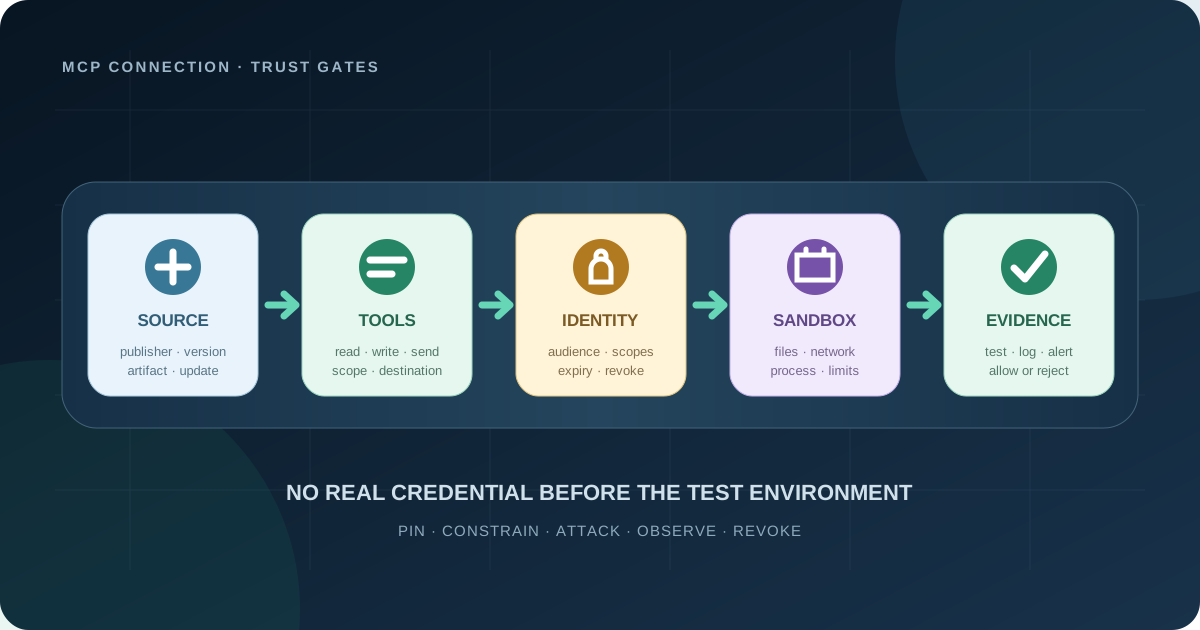
Audit an MCP server before it receives a real credential. Verify the publisher and artifact, enumerate every exposed tool, map data movement, restrict identity, isolate execution, test hostile inputs, and prove that one action can be reconstructed and revoked. A polished install command or OAuth screen is not evidence that the integration is safe.
Why MCP server security needs a separate review
Model Context Protocol standardizes how AI applications discover tools and data sources. That convenience compresses integration work, but it does not transfer responsibility for trusting the server. The protocol project's own security policy says clients trust the servers they connect to, local servers run with the access available to their process, and users or administrators are responsible for server selection and configuration.
The attack surface is also moving quickly. The final MCP specification dated 28 July 2026 introduced authorization hardening and a stateless core. OWASP published a dedicated secure MCP server guide in February 2026. McKinsey's 2026 AI Trust Maturity Survey found security and risk were the most frequently cited barrier to fully scaling agentic AI, while agentic governance and controls remained among the less mature dimensions.
This does not mean every MCP server is dangerous. It means the right unit of review is the entire path: package or remote service, configuration, credentials, tool definitions, model, host, downstream APIs, logs, and operator. Reviewing only the protocol name or repository README leaves the consequential parts untested.
Start with a one-page trust-boundary record
Write the business use case in one sentence: who needs the connection, what outcome it supports, and why a narrower API or read-only export is insufficient. Then draw the path from user request to model, MCP client, server, downstream system, and external destination. Mark every point where instructions, data, credentials, or side effects cross an ownership boundary.
| Boundary | Question to answer | Required evidence |
|---|---|---|
| Distribution | What code or service are we trusting? | Publisher, source, version, digest, dependencies |
| Capability | What can it read, change, send, or execute? | Tool inventory and tested behavior |
| Identity | Whose authority reaches each system? | Token audience, scopes, roles, expiry |
| Runtime | What can the server process reach? | Filesystem, network, environment, subprocess policy |
| Evidence | Can we explain and contain one action? | Correlated logs, alerts, revocation runbook |
Name a business owner and a technical owner. Record whether the server is local or remote, the data classification it can encounter, the maximum credible impact, the review date, and the emergency disable path. If nobody owns the connection after installation, reject it before deeper testing.
Verify the publisher, artifact, and update path
A local MCP server is executable software. Its install command may download a package, run lifecycle scripts, read environment variables, and inherit the user's filesystem and network access. A remote server replaces some host risk with service, tenancy, retention, and vendor risk. Audit accordingly.
- Resolve the canonical publisher from an official product site or verified organization. Do not trust a package because its name resembles a known brand.
- Inspect source availability, license, security policy, maintainer activity, release history, unresolved security reports, and ownership changes.
- Pin an exact version and lock transitive dependencies. Record the artifact digest where the delivery method supports it.
- Read install and post-install scripts. Search for shell execution, unrestricted file access, credential discovery, telemetry, and outbound endpoints.
- List every domain contacted during installation, startup, discovery, authentication, tool calls, updates, and diagnostics. Explain or block undeclared traffic.
- Define how updates are reviewed. Automatic movement to an untested server version turns a one-time audit into temporary reassurance.
For a managed remote server, request its subprocessor list, data location, retention and training policy, tenant isolation, vulnerability disclosure process, incident-notification terms, availability design, export path, and deletion mechanism. A familiar SaaS brand does not make every newly exposed MCP tool appropriate for every tenant.
Inventory what the server actually exposes
Capture the output of tool and resource discovery in a clean test environment. For every tool, record its description, input schema, downstream API, data read, possible write, destination, required scope, reversibility, rate limit, and approval rule. Compare the advertised capability with runtime behavior.
Descriptions are part of the control surface because the model uses them to choose tools. Look for instructions that are hidden, misleading, overly broad, or unrelated to the stated function. Re-run discovery after an update and alert when a tool, description, schema, resource, prompt, or UI template changes.
Server: crm-mcp-prod
Version: 2.4.1 + artifact digest
Tool: create_follow_up
Reads: lead id, owner, status
Writes: one task; no contact fields
Destination: company CRM only
Identity: dedicated agent role
Approval: required for external message only
Limits: 50 tasks/hour; one open task/lead
Evidence: initiator, arguments, policy, result id
Disable: revoke role + remove server allowlist entry
Prefer purpose-built operations such as create_follow_up over generic SQL, shell, browser, or filesystem tools. If a general tool is genuinely required, treat it as high privilege and reduce its runtime reach. The existing AI agent permission matrix explains how to classify actions; this audit determines whether the connector can enforce those boundaries.
Check authentication, authorization, and delegation
Do not place long-lived secrets in prompts, configuration committed to source control, command arguments visible to other processes, or URLs. Use a managed secret store and short-lived credentials where supported. Give the server or agent a distinct identity so its actions can be attributed and revoked without disabling an employee.
For a remote protected server, verify current MCP authorization behavior rather than assuming that an OAuth login makes it safe. The protocol's authorization specification builds on OAuth and protected-resource metadata. The current security guidance explicitly forbids token passthrough and requires a server to reject tokens not issued for that server.
- Validate issuer, signature, audience, expiry, client, scopes, and user or workload context on every request.
- Separate the token used to call the MCP server from credentials the server uses for a downstream API. Never forward a client token blindly.
- Grant read and write through different scopes or roles. Restrict tenant, project, repository, folder, table, record type, field, and action where the destination supports it.
- Keep development, test, and production identities separate. Never test a candidate server with a production administrator credential.
- Test revocation, expiry, user departure, role change, consent withdrawal, and cross-tenant attempts. Verify failure at the downstream system, not only in the model prompt.
NIST's 2026 agent identity concept treats identification, authorization, auditing, non-repudiation, and prompt-injection controls as connected. Your evidence should preserve both the initiating human or process and the executing agent identity.
Constrain local and remote runtimes
Run a candidate local server as a non-administrator in a disposable environment first. Mount only required directories, read-only where possible. Pass only named environment variables. Block child processes unless the use case needs them. Use an outbound network allowlist and deny access to cloud metadata, local control sockets, unrelated internal services, and arbitrary internet destinations.
The MCP project notes that stdio clients intentionally launch a configured process and that it inherits available privileges. The safe response is not to label that behavior a protocol flaw; it is to minimize those privileges. Containers can help but are not a complete boundary if they mount sensitive host paths, expose a privileged socket, run as root, or have unrestricted networking.
For a remote server, put egress and API policy at a gateway you control where practical. Set request, concurrency, data-size, cost, and action limits. Use idempotency for writes. Time out safely, retry only operations designed for retry, and prevent a partial failure from being interpreted as success.
Test hostile content, tool changes, and failure states
Google's MCP security guidance distinguishes human-approved and agent-only operation, but warns that human review can still fail when people over-trust a proposed action. Approval is useful only when it displays the exact tool, destination, arguments, affected records, source, and consequences.
Build a negative-test pack before production:
- A document, email, ticket, webpage, or database row instructs the agent to ignore policy, expose a secret, or use another tool.
- A server changes a tool description or schema after initial approval.
- Two tools are safe alone but create an unsafe chain, such as reading private data and sending an external message.
- An argument includes path traversal, command characters, oversized content, an internal URL, or another tenant's identifier.
- A write succeeds but its response times out; the client retries.
- A credential is expired, revoked, intended for another audience, or carries excess scope.
- The downstream API returns partial data, a delayed error, a rate limit, or an unexpected redirect.
- The server attempts undeclared DNS, network, filesystem, environment, or subprocess access.
Test in observe-only or draft mode before enabling writes. Seed canary records and use synthetic credentials. Confirm that prohibited actions fail closed, alerts reach a named person, and the business can continue manually while the connection is paused.
Log the request, decision, action, and outcome
A conventional API log may show that an endpoint returned 200. An agent incident also needs the initiating user or event, agent and server versions, available tool set, chosen tool, sanitized arguments, policy decision, approval, downstream identity, result, side effect, latency, and correlation identifier. Protect logs from the agent they describe and redact secrets and unnecessary personal data.
OpenAI's description of operating coding agents safely illustrates the distinction: it combines traditional host signals with agent-native events such as prompts, approval decisions, tool results, MCP use, and network-policy decisions. Use the principle, not a vendor-specific log format.
Alert on first access to a sensitive source, new tools, scope changes, unusual volume, new destinations, repeated denials, approval spikes, secret-like output, and attempts to disable logging. Quarterly review is not enough for a connection that can act at machine speed.
Use an explicit allow, limit, or reject decision
| Decision | When it fits | Next control |
|---|---|---|
| Allow | Verified source, narrow tools, scoped identity, contained runtime, passing tests | Pin version; monitor drift; set review date |
| Limit | Useful but evidence or controls are incomplete | Read-only, test data, no external side effects |
| Reject | Unknown publisher, unexplained access, shared admin credential, poor logs, no revocation | Choose a direct API, export, or different server |
Store the decision with the capability manifest, test results, known limitations, owners, expiry date, update policy, and kill procedure. Re-review after a server, client, model, scope, downstream API, authentication flow, or ownership change. Discovery drift should automatically move the connection back to limited mode until reviewed.
This is a security engineering framework, not a certification. No checklist proves that an agent or server is harmless. The objective is to reduce authority, expose changes, catch predictable failure modes, and make containment faster than improvisation.
Frequently asked questions
Is MCP itself insecure?
No. MCP is a protocol with an explicit trust model and evolving security guidance. Risk depends on the server implementation, client, configuration, credentials, model behavior, downstream systems, and operator controls.
Is a local MCP server safer than a remote one?
Not automatically. A local server reduces some third-party service exposure but executes software on your machine with the process's file, environment, and network access. A remote server introduces service, tenancy, retention, and vendor controls. Audit the actual boundary.
Can OAuth make an MCP server safe?
OAuth can establish delegated access, but only when issuer, audience, scopes, redirect behavior, token handling, and downstream authorization are correct. It does not validate tool behavior, package integrity, prompt-injection resistance, runtime isolation, or logging.
Should every MCP tool call require human approval?
No. Require meaningful approval for consequential or unusual operations. Allow narrow, reversible, low-impact actions only inside deterministic limits. Block prohibited actions in code rather than asking a tired person to approve them.
What is the fastest useful MCP security check?
Before entering credentials, identify the publisher, list tools, map reads and writes, inspect install behavior and network destinations, run with synthetic data and least privilege, try hostile inputs, verify logs, and prove one-step revocation.
Sources and verification date
Verified 16 September 2026 against the MCP project's trust model, 2026 security practices, and 28 July specification overview; OWASP's secure MCP development guide; Google's MCP security guidance; NIST's agent identity work; and OpenAI's agent telemetry case study.
Rendframe can inventory an MCP estate, review a candidate server, design a constrained gateway, build negative tests, and connect agent-native telemetry to incident response. First define authority with the agent permission matrix, then review Rendframe's AI automation service or send us one server, use case, and proposed credential scope.