“Shopify or WooCommerce?” sounds like a website-builder question. It is really a decision about who will own hosting, updates, checkout, integrations, and the 2 a.m. failure for the next three years: a platform, your team, or a developer.
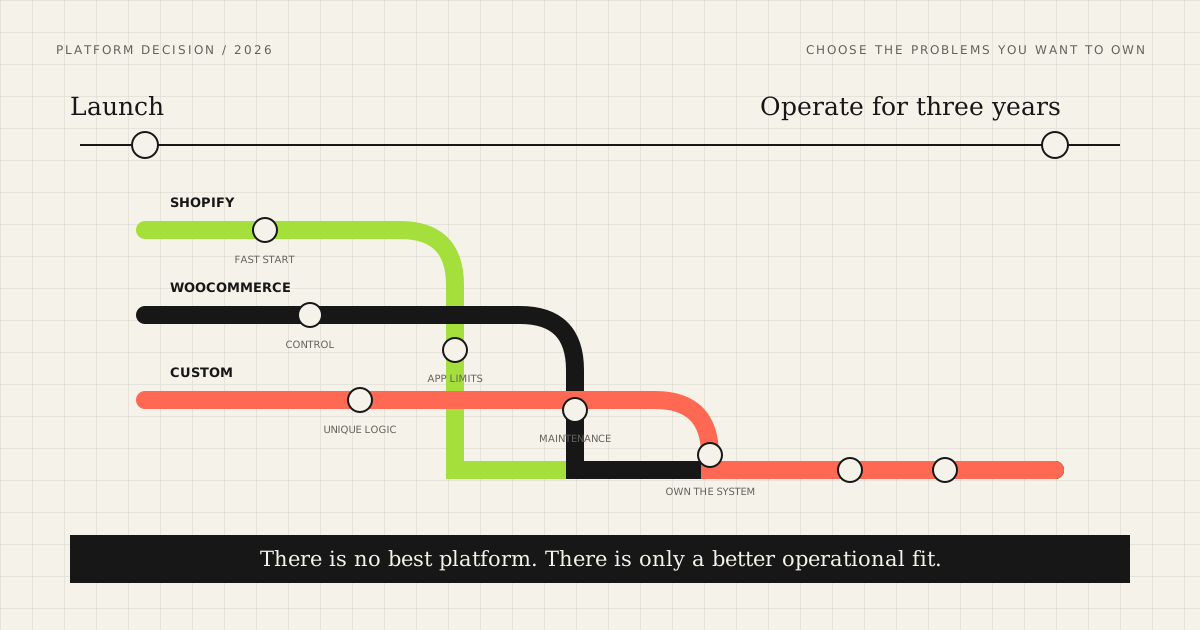
For a conventional DTC store whose main job is to start selling, Shopify is often the sensible default. If the business is content-led, already runs on WordPress, or needs unusual rules and control, WooCommerce may fit better. Fully custom commerce becomes rational when a standard platform blocks a proven way to make money—not when a founder merely wants something unique.
This is an independent comparison with no affiliate links. Prices were checked on August 16, 2026; local rates, taxes, and payment fees vary.
The short verdict
Shopify
Standard catalog, small team, quick launch, little technical routine.
Woo
WordPress, content-led growth, data control, unusual business rules.
Custom
Commerce is the product and a proven process does not fit apps.
Too soon
No sales proof, operational owner, or ongoing software budget.
These are not three versions of the same product
Shopify is hosted SaaS: hosting, baseline security, checkout, and platform updates are included. WooCommerce is an open-source WordPress plugin: core is free, while you assemble hosting, theme, extensions, payments, backups, and support. Custom is not a prettier design. It is a software product with architecture, tests, observability, release processes, and incident ownership.
Comparing only monthly fees is like comparing a taxi, a private car, and an automobile factory by the price of fuel.
Shopify vs WooCommerce vs custom—without the marketing fog
| Criterion | Shopify | WooCommerce | Custom |
|---|---|---|---|
| Launch | Days or weeks | Weeks | Months |
| Infrastructure | Mostly Shopify | You, host, or agency | Your team |
| Customization | Themes, apps, APIs, platform limits | Broad; code access | Almost unlimited |
| Maintenance | Low; apps still need control | Updates, staging, backups, security | Full product lifecycle |
| Content | Enough for most stores | Strong WordPress workflow | Whatever you build |
| Checkout | Mature hosted checkout | Flexible; depends on stack | Your advantage and risk |
| Control | Exports/APIs; closed platform | Own database and codebase | Full control and responsibility |
Real cost means three years, not the sticker price
Shopify Basic currently lists at $29/month on annual billing or $39 monthly; Grow at $79/$105; Advanced at $299/$399; Plus starts at $2,300/month. The real bill also includes themes, apps, payment processing and, in some cases, added fees for third-party payment providers.
WooCommerce core is free. Woo estimates hosting at $25–$350/month for most stores and extensions at roughly $29–$299 per year each. Add setup, staging, backups, monitoring, developer hours, and compatibility work. “Free” describes the software license, not operations.
| Scenario | Year one | Each later year | Includes |
|---|---|---|---|
| Lean Shopify | $2k–$8k | $1k–$5k | Plan, setup, 3–6 apps |
| Serious Shopify | $15k–$60k | $8k–$35k | Custom theme, integrations, iteration |
| Lean WooCommerce | $4k–$15k | $2k–$10k | Hosting, theme, plugins, maintenance |
| Complex WooCommerce | $20k–$80k | $10k–$45k | Custom logic and operations |
| Custom commerce | $80k–$300k+ | $40k–$180k+ | Team, cloud, QA, security, roadmap |
These are planning ranges, not quotes, and exclude payment processing. Model platform + apps/extensions + hosting + development + internal operations + payment fees + migration risk.
Choose Shopify when
Your catalog, promotion, inventory, fulfillment, and checkout are largely conventional; the team wants to run merchandising rather than servers; launch speed matters more than absolute freedom; and a broad app ecosystem is valuable. Shopify does not mean a generic design: themes can be custom and the Storefront API supports headless builds. But headless Shopify is a software project, not a shortcut.
Warning signs: a critical payment provider is unsupported; the model needs deep checkout behavior outside your plan; ten apps rewrite the cart; subscriptions rise faster than revenue; the product does not fit Shopify's data model.
Choose WooCommerce when
WordPress already drives marketing; complex editorial content matters; you need unusual pricing, configuration, or local integrations; and a reliable technical owner exists. Woo's flexibility is also its operational risk. WordPress, WooCommerce, the theme, payment gateway, and plugins change independently. Official Woo guidance for larger stores includes staging, version control, backups, monitoring, suitable infrastructure, and a team to support it.
Warning signs: nobody owns updates; production is the test environment; forty plugins have no inventory; shared hosting is chosen only for price; backups have never been restored; an agency owns the credentials and custom code.
Choose custom commerce only when the constraint is valuable
Custom can make sense for a complex marketplace, rules-heavy configurator, regulated ordering, unusual B2B contracts, real-time inventory across systems, or a checkout that creates a genuine competitive advantage.
- Is the limitation causing measurable loss today?
- Have platform features and app workarounds been tested?
- Are the data model and business rules written down?
- Can the advantage repay both the build and three years of operations?
- Who owns security, uptime, releases, and incidents?
If all five answers are not strong, custom is probably premature. A hybrid is often smarter: Shopify or Woo as the commerce engine, with custom software only where the unique logic lives.
SEO, speed, and conversion are not platform switches
WooCommerce is not automatically better for SEO, and Shopify does not make every store convert better. Shopify provides a strong operational baseline and mature checkout; WordPress provides a more flexible content model. Organic growth still depends on search intent, useful pages, architecture, internal links, structured data, reputation, and technical quality.
Performance is similar. A fast theme on either platform can be ruined by eighteen marketing scripts, oversized images, and a careless app stack. Measure real templates and users, not the homepage demo.
Migration is more than export and import
A move includes products, variants, customers, order history, discounts, subscriptions, reviews, gift cards, tax, redirects, analytics continuity, email flows, and staff training. Shopify and WooCommerce use different URL structures; without a redirect map, organic landing pages can disappear.
Check the exit before choosing: exports, theme-code ownership, subscription portability, URL changes, and irreplaceable apps. Lock-in is not binary. An open-source store can be locked to a bad custom plugin understood by one person.
Make the decision in 30 minutes
- Shopify when 80–90% of the operation is standard and the team should focus on product, operations, and acquisition.
- WooCommerce when content and control matter, and technical operations have a named owner.
- Custom when unique logic has proven revenue impact and the business is ready to operate software.
Frequently asked questions
Is Shopify or WooCommerce better for a small business?
Shopify is usually the safer first-store default. WooCommerce fits businesses already on WordPress, dependent on content, or needing control with technical ownership.
Is WooCommerce really free?
The core plugin is. Hosting, themes, extensions, payments, backups, security, and maintenance make total cost greater than zero.
Is Shopify more expensive than WooCommerce?
Not necessarily. Shopify has a visible subscription; Woo often moves costs into hosting and developer time. Compare an identical scope over three years.
When should a business build custom ecommerce?
When unique commerce logic creates proven value, standard platforms cannot solve it economically, and the company can operate software continuously.
Can a store migrate between Shopify and WooCommerce?
Yes, but data mapping, redirects, subscriptions, reviews, analytics continuity, and QA make it a real project—not a CSV import.
Sources and review date
Pricing was reviewed on August 16, 2026 using official Shopify Pricing and WooCommerce Pricing. Third-party payment terms come from the Shopify Help Center; Woo operational requirements come from its official scaling FAQ. Cost ranges are planning models, not price lists.
Read next: run a one-day checkout audit and calculate technology ROI before building.